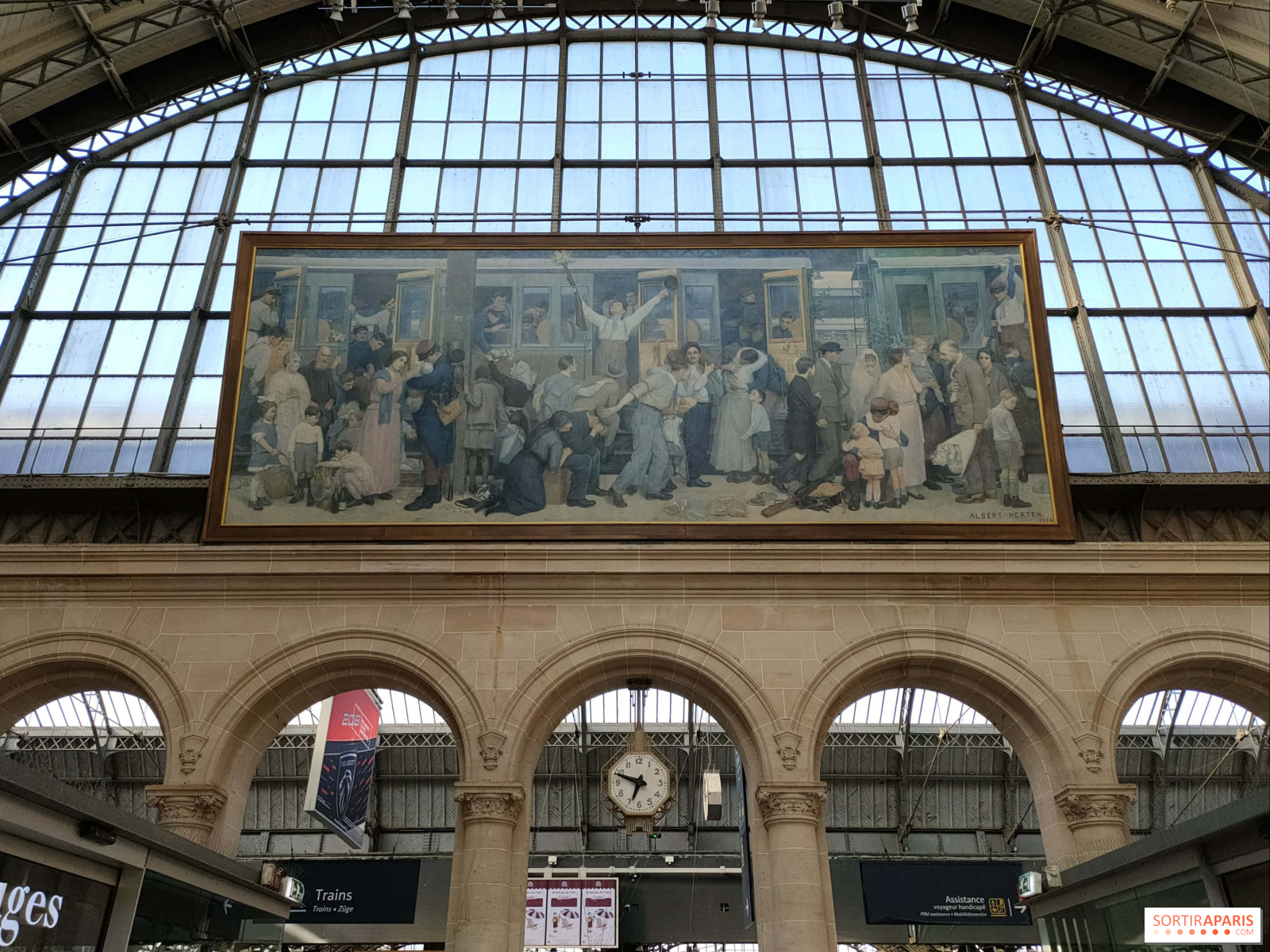
At Gare de l’Est, many look for their platform, their coffee, or their connection, but few lift their eyes to the immense tableau hanging in the hall d’Alsace: "The Departure of the Poilus, August 1914". Yet this work, 12 meters wide by 5 meters tall, is not mere decoration: it is a monument of memory.
Painted by the American artist Albert Herter, it depicts the departure of French soldiers mobilized in August 1914. The gare de l’Est was not chosen by chance: it is through this station that a large number of soldiers headed to the front at the outset of the First World War.
The story grows even more poignant when you study the painting up close. Albert Herter offers it to France in 1926, in memory of son fils Everit Herter, engagé volontaire dans les troupes américaines et mort dans l’Aisne, près de Château-Thierry, en 1918.
In the scene, the young soldier at the center, with his arm raised, is said to be inspired by Everit. The painter would also have slipped his own portrait into the composition, as well as that of his wife. The painting then becomes a kind of immense family album, hanging in a railway station where strangers pass by.

What strikes about this gigantic canvas is the contrast. One can almost hear the cries, the farewells, the trains, the steam, the flowers tossed to the soldiers. Yet the painting stays frozen in an almost solemn moment. Families wave, children watch, the soldiers depart. And as we know now—though many did not in August 1914—the war would be long and terrible.
The painting has led a turbulent life. Withdrawn in 1948 for cleaning, reinstalled in 1964, and then moved again during the works related to the TGV Est, it found its place again after restoration in early 2008. Today, it continues to watch over the Gare de l'Est, as if reminding travelers that some destinations were not holidays, but departures with no guarantee of return.
Gare de l’Est, the story of the station that opened Paris to the East
At the gates of Alsace, Lorraine, Germany and Central Europe, the Gare de l'Est has sent millions of travelers on their way, as well as soldiers, during France’s darkest hours. [Read more]
Location
Gare de l'Est
Rue du 8 Mai 1945
75010 Paris 10
Route planner
Accessibility info



























 Gare de l’Est, the story of the station that opened Paris to the East