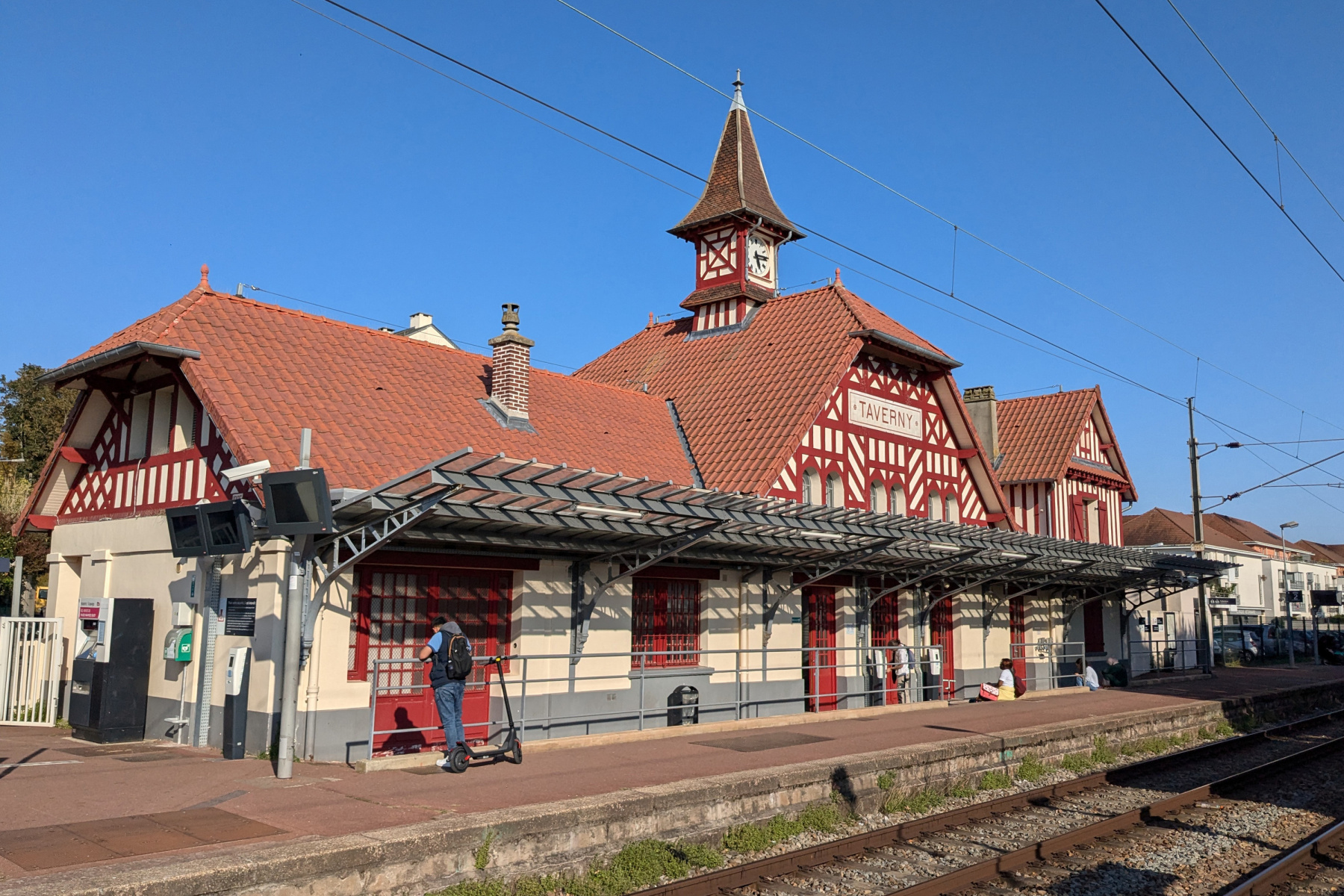
Every day, thousands of travelers pass by it without necessarily noticing. Yet the gare de Taverny immediately stands out from the other stations on the line thanks to its distinctive silhouette, marked by a clock tower and half-timbered façades that are uncommon in the Île-de-France rail landscape. This building, in its own way, tells the story of the city’s growth and the development of transport in the Paris suburbs.
Like many French railway stations, its name simply reflects the town it serves. Taverny station opened in 1876 by the Compagnie des chemins de fer du Nord with the launch of the line linking Ermont to Valmondois. At the time, it was a modest building, designed mainly to meet the needs of rail traffic. Its story is thus closely tied to the arrival of the train in this part of the Val-d'Oise, which gradually transformed travel and spurred the urban development of the commune.
What gives the place its distinctive character today was forged in the interwar period. The station was expanded and extensively redesigned, with the construction of a spacious concourse, the addition of a clock tower, and the adoption of a half-timbered decor inspired by the then-fashionable regionalist architecture. This transformation lends it a look almost surprising for a suburban station. More than a mere railway facility, the building has become a true landmark in the urban landscape, instantly recognizable at a glance.
Nearly 150 years after its opening, the station continues to welcome passengers on the ligne H while preserving the elements that give it its architectural character. Restored and maintained over the years, it testifies to a period when railway companies also sought to give their buildings an aesthetic identity. A feature that today makes it one of the most notable stations in the historic network of northern Île-de-France.
This page may contain AI-assisted elements, more information here.