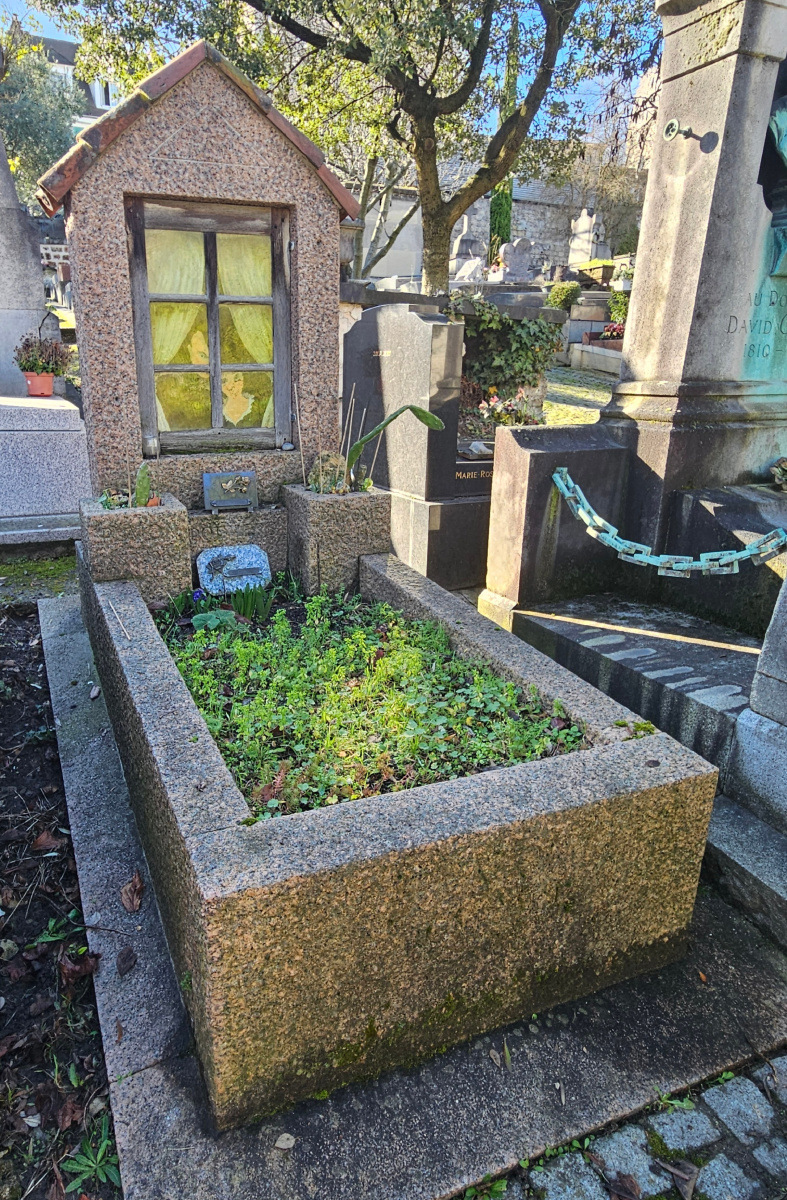
In Montmartre, there is a little house whose occupants never leave… yet still watch the living go by! Tucked away in the lanes of Saint-Vincent Cemetery, in the 18th arrondissement of Paris, this unusual tomb is unlike any other. With its tiled roof, window and curtains, it looks like a miniature cottage. But the most surprising thing lies behind the glass: a man and a woman seem to be watching visitors, as if they were sitting comfortably at home. This unusual grave is both touching and intriguing, and tells a lovely story of love and artistic creation in the heart of old Montmartre.
You have to get closer to understand what makes this tomb so unusual. Behind the curtains of this curious funerary house, two figures are depicted side by side, gazing outwards. These mysterious occupants are none other than Papoue (1908–1961) and her husband Platon Argyriadès (1888–1968), two artists closely linked to the history of Montmartre.
Platon, whose full name was Nicolas Platon Constantin Argyriades, was a ceramicist, faience maker and glassmaker, among other things. With his wife, he cultivated a world where craftsmanship and poetry met. On their grave, one word wonderfully sums up this combination: “poétiers”. A charming portmanteau of “poets” and “potters,” it reflects their way of blending artistic creation and imagination.
Their funerary monument also embraces a naïve aesthetic, characterized by a simple, familiar, almost childlike depiction of everyday life. There’s no grand, solemn statue here—just two lovers who seem to have decided to spend eternity watching the world from their window.
The story of this unusual grave becomes even more poignant when we learn about the past of its occupants. According to several Montmartre chroniclers, Platon was one of the last residents of the famous Mimi Pinson’s house, a former little house at 18 rue du Mont-Cenis.
This house, which became one of the symbols of bohemian Montmartre, really did exist. The Musée Carnavalet holds, among other things, old depictions of it and notes that it was demolished in 1925. As for Mimi Pinson, she was not a mysterious owner but a literary character imagined by Alfred de Musset in 1845, who became a popular figure representing the Parisian grisette and the world of artists. Papoue died in 1961, seven years before her husband. Yet on this small façade, they are together forever, side by side.
It might therefore be tempting to see Papoue and Platon’s tomb as a tribute to the little house that has disappeared. However, no document allows us to say that the funerary monument was directly inspired by it.
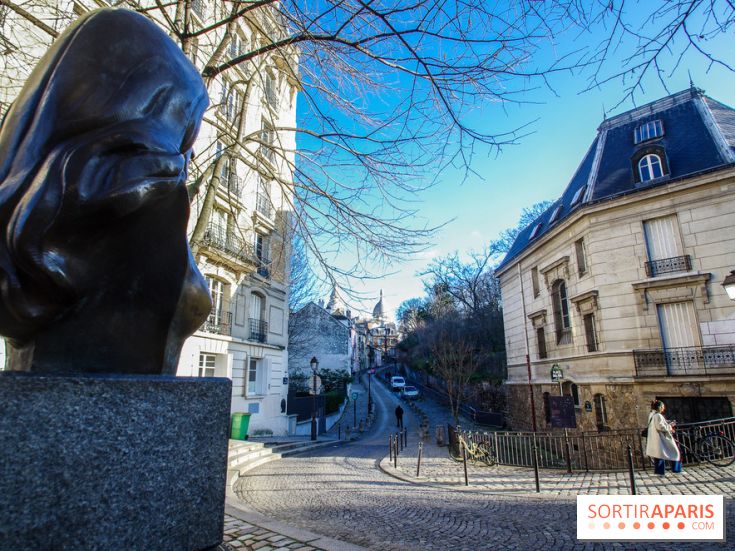
To discover this astonishing little funerary house, head to Saint-Vincent Cemetery, at 6 rue Lucien-Gaulard, just a short walk from the Montmartre vineyards and the Lapin Agile cabaret. Be careful not to confuse it with the large Montmartre Cemetery farther downhill, near Place de Clichy!
Opened in 1831, this small, little-known cemetery is the final resting place of many figures associated with the neighborhood’s artistic history. The tomb of Papoue and Platon is in the 13th division, where it is marked as number 48 on the official map of notable graves.
And if you pass by their little house, take a moment to look at the window. After all, it’s not every day you come across a tomb whose occupants seem just as curious to see their visitors!
This page may contain AI-assisted elements, more information here.
Location
Saint-Vincent de Montmartre Cemetery
6 Rue Lucien Gaulard
75018 Paris 18
Route planner
Accessibility info