Artificial intelligence is coming to French roads to track down offenses. Automatic speed cameras will take a major technological leap forward in 2026 with features that go far beyond simple speed control. Failure to maintain a safe distance, using a handheld phone while driving, and not wearing a seatbelt will now be detected automatically. This revolution is part of the 2025 finance bill, with a budget of €46.3 million dedicated to modernizing the speed camera network. While the total number of cameras is expected to increase from 4,000 to 4,160, it is their detection capabilities that will really explode.
Gone are the days when these offenses slipped through the net. Thanks to cutting-edge technology combining high-definition video and artificial intelligence, speed cameras will be able to identify several traffic violations simultaneously. Florence Guillaume, interministerial delegate for road safety, explains in a memo published by the French Ministry of Finance that this development will be made possible by "the adoption of innovative technology and techniques, such as the expanded use of artificial intelligence to improve the performance of automated enforcement." In concrete terms, AI will analyze the images captured to identify drivers holding their smartphones, check whether seat belts are being worn, or measure the distance between two moving vehicles.
Before the arrival of these smart speed cameras, several types of equipment were already in use in France. Fixed speed cameras, permanently installed on poles or in cabins, mainly monitor high-traffic roads. These devices only check speed, and some models are bidirectional, capable of flashing vehicles in both directions of traffic. There are also mobile speed cameras, installed in unmarked cars that are either moving or stationary, which monitor speed without a visible flash.
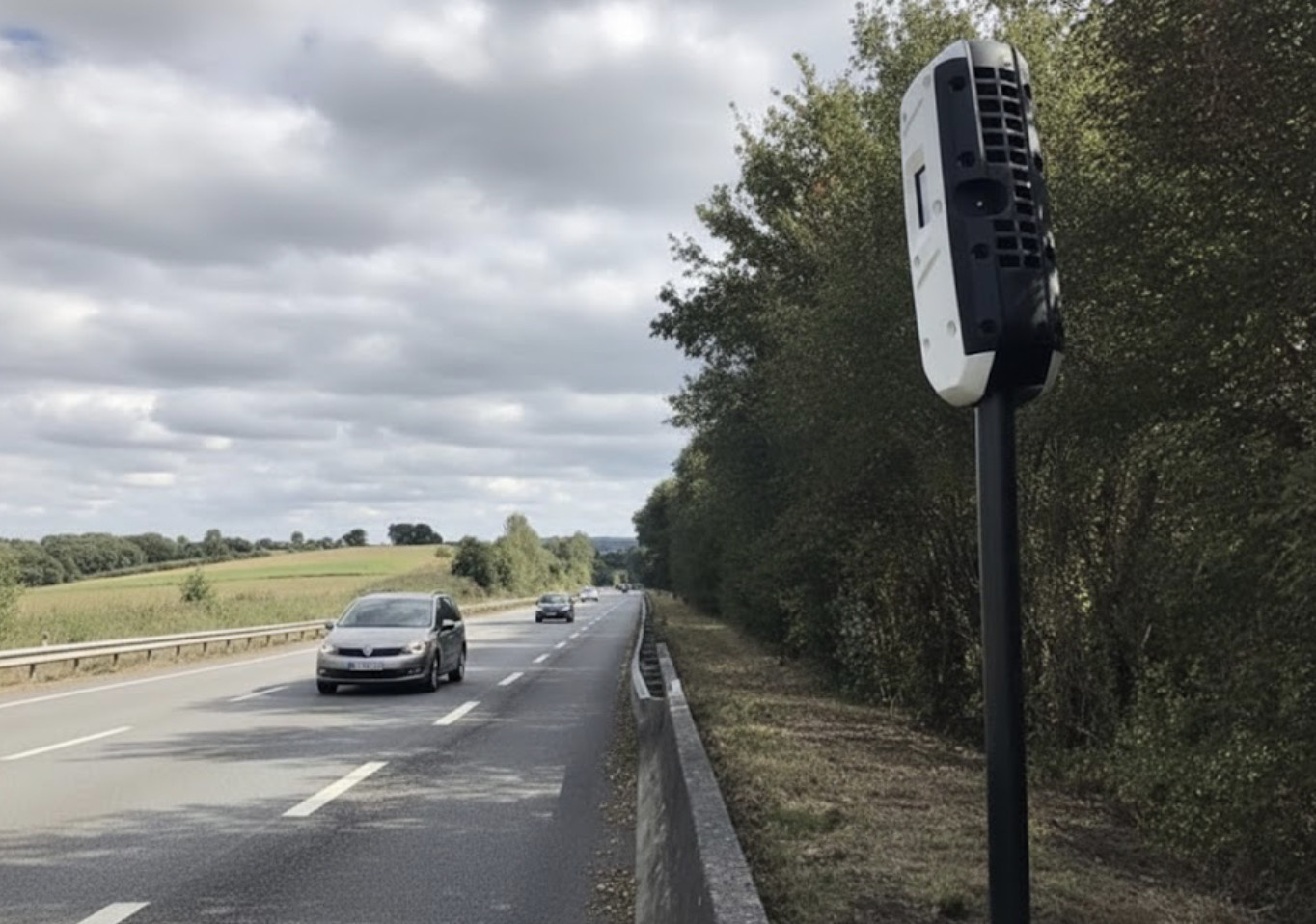
Turret radars, known as Mesta Fusion 2, represent a newer generation. These large devices, installed on masts, use infrared technology that is invisible to the naked eye to photograph vehicles that are breaking the law. They theoretically have extensive capabilities but are currently limited to speed checks, red light violations, and level crossing violations. The reprogramming planned for 2026 will transform several hundred of these existing devices into electronic eyes capable of detecting many more offenses. The number of turret radars is even expected to increase from 600 to 1,700 units by 2028.
Manufacturers presented this revolutionary equipment in November 2024 at the Salon des maires (Mayors' Exhibition) and Milipol, the global event for safety and internal security. These new-generation radars offer significantly higher image accuracy than current models. The Mesta Fusion 2 turret radar features a 36-megapixel optical sensor and a multi-target Doppler radar antenna with a 3D beam to measure distances and track trajectories, as explained by L'Argus in its investigation.
Artificial intelligence coupled with video technology makes it possible to analyze driver behavior in real time and detect several offenses simultaneously. You can even be caught for speeding AND using your phone while driving during the same passage in front of the radar. The Automated Control Department (DCA) has launched a call for tenders to collaborate with companies capable of managing these new-generation radars. Algorithms continuously analyze images and compare detected behaviors with predefined models, transmitting only those images that exceed a predetermined confidence threshold to the Automated Traffic Offense Detection Center.
The planned budget will also enable the purchase of new vehicles for mobile speed cameras, the maintenance of the existing fleet, and, above all, the repair of the most vandalized equipment. This is a significant investment that demonstrates the government's commitment to strengthening automated road surveillance.
If you are caught red-handed by these devices, be prepared to pay. Each of these offenses will cost you a $150 fine and result in three points being deducted from your driver's license, just as in a conventional traffic stop by law enforcement. Failure to maintain a safe distance between vehicles, also known as following distance, will be particularly monitored on highways where drivers tend to tailgate the vehicle in front of them.
But beware, penalties can be cumulative. As Jean-Baptiste Losca, a traffic lawyer, points out, a driver can lose up to 8 points and pay €405 for a single pass in front of a camera if they commit all three offenses. "You can't lose more than eight points at a time," says the lawyer, who believes that "many people will be affected." For a young driver with only six points during their probationary period, two simultaneous offenses are enough to lose their license. In the city, in heavy traffic, detection will obviously be more complex.
The question remains: will these radars really be able to reliably detect a driver who is not wearing a seatbelt or holding their phone? Tests carried out in the United Kingdom since 2023 have shown the system to be effective. On a road in Cornwall, the device detected more than 300 offenses in 72 hours, including 117 for using a phone while driving. According to the government, AI should significantly improve the rate at which flashes are converted into actual traffic tickets.
The timeline will depend on manufacturers and the progress of the approval process for these new features. Road Safety plans to begin deployment in 2026, with a gradual ramp-up until 2030. Given the desired budget for these new radars, a public tender should be launched quickly to meet the deadlines. The first fines could be issued as early as 2026, although widespread implementation will take several months.
Among the planned innovations, multi-section speed cameras will measure the average speed of vehicles over longer distances and on various types of roads. Discriminating radars will evolve with a dual-face ETD2F system, incorporating 3D lidar to assess the distance between vehicles. Urban radars will also undergo "iterative, incremental, and agile" developments to cover new functions such as non-compliance with bus lanes or congestion at intersections.
Another change is planned: the government is considering reintroducing visible flashes on some of the speed cameras that currently use infrared technology. Since 2019, around a quarter of French speed cameras, notably Mesta Fusion 2 and turret cameras, have been flashing invisibly to the naked eye. This discretion could soon come to an end for some equipment. This return to basics is sure to reawaken the reflexes of drivers who are used to this characteristic light signal.
In short, vigilance will be the order of the day on French roads in 2026. These smart speed cameras mark a new stage in road safety, with tenfold detection capabilities that leave little room for error. To avoid unpleasant surprises, there is only one solution: strictly obey the rules of the road, hang up your phone, fasten your seatbelt, and maintain a reasonable distance from the vehicle in front of you. You can find all the official information on road safety on the Road Safety website.
Recommended age
For all