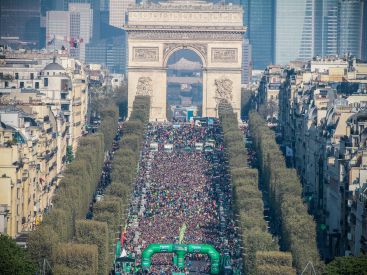
If you’ve never taken part in a half-marathon, a marathon, or any other race that requires a minimum training, don’t worry: with a few months to go before race day, you still have time to seriously prepare to run a little over 21km or 42km, depending on whether you’re aiming for the Paris Half Marathon 2027, scheduled for March 7, 2027, or the Paris Marathon 2027, set for April 4, 2027.
At first, the goal isn’t yet to rack up miles, but to gradually build a solid base. For a beginner, the consistency matters a lot more than speed!
For a first half-marathon, a 21.1km race, a beginner can usually structure training around three workouts a week: two shorter runs and one longer session. There’s no need to tackle 20km right away. Focus on building endurance first, and as the weeks go by the long run can gradually extend to about 1h30 to 2h, depending on your level and your plan.
You can also gradually introduce a slightly more dynamic session: light accelerations, short intervals, or portions run at the pace you’re aiming for in the half-marathon. But endurance remains the priority! A 10km race held a few weeks or months before race day can also be an excellent real-world test: tackling the start, fueling, the crowd, your kit, breakfast and pre-race nerves—to put yourself through real race conditions!
For a first marathon, the 42.195 km dramatically changes the game. If you’re starting from scratch, the first months should mainly be about becoming a regular runner before tackling a more marathon-specific plan. In the long run, you’ll typically aim for 3 to 4 sessions per week. The long run becomes essential, but it’s pointless (even potentially counterproductive) to run 42 km in training; it will gradually increase as your preparation progresses.
Moreover, it’s particularly worthwhile to work up to intermediate distances: 10K, then a half-marathon, for instance. They let you learn to pace yourself and verify that your training is progressing properly. The marathon also requires you to dial in your fueling. After several hours of effort, starting too fast or not eating enough can end up costing you far more than a few seconds lost at the start!
In any case, think first of being a finisher rather than chasing a time; starting out at a deliberately cautious pace in the early kilometres can make a huge difference in the last third of the race!
Paris Marathon 2027: When the capital's biggest race takes place and how to register
The 50th Paris Marathon will take place on Sunday, April 4, 2027. Once again, runners will thread through the capital, passing by some of Paris’s most beautiful sights. Who will cross the line first? [Read more]
Runners are lining up for March 7, 2027, for another edition of the Paris Half Marathon that looks as spectacular as ever. A chance to set new records at the start of the year! [Read more]
Dates and Opening Time
From March 7, 2027 to April 4, 2027
Official website
www.asicsmarathondeparis.com































 Paris Marathon 2027: When the capital's biggest race takes place and how to register


 Paris Half Marathon 2027: When is the Parisian half marathon and how to register