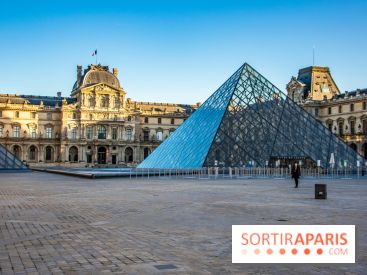
The Louvre Museum is hosting this autumn an unprecedented exhibition dedicated to Spanish Baroque sculpture, titled "Sculpting Color - Masterpieces from the Museo Nacional de Escultura, Valladolid". On show at the Napoleon Hall, in Paris’s 1st arrondissement, from 7 October 2026 to 25 January 2027, it brings together 23 premier works, all loaned by the Museo Nacional de Escultura de Valladolid, the Spanish national museum devoted to sculpture, as part of an exclusive partnership.
Notable feature: this exhibition is presented simultaneously and in the same space as the retrospective dedicated to Francisco de Zurbarán, with a scenography conceived jointly to foster a dialogue of eyes between the two disciplines. Two exhibitions for the price of one ticket, and a rare artistic dialogue not to be missed this autumn in Paris.
At the heart of this exhibition stands a distinctly Baroque Spanish art: polychrome wood religious sculpture. These works, marked by striking naturalism, were crafted to stir the faithful’s spiritual emotion, depicting saints, Christ on the cross, and the Virgin with anatomical precision and dramatic intensity that rival the era’s greatest paintings. In this period, painting and sculpture share a close bond, as seen in artists such as Alonso Cano, who pursued both disciplines at once. It is precisely this dialogue that the show makes visible, placing these works in direct dialogue with canvases by Zurbarán, Velázquez, and Murillo. For a deeper dive on this subject, discover our selection of painting exhibitions not to miss in Paris and Île-de-France.
The centerpiece is a complete paso de procesión by Gregorio Fernández, a monumental group of five life-sized carved and painted figures dating from the early 17th century, presented at human height to allow close observation. These pasos, designed to be carried in Holy Week processions, are a specialty of Valladolid. Seeing such a set in Paris, in the Hall Napoléon, is a rare event.
Among the other major loans, all never before seen in France, the highlights include Gregorio Fernández's Cristo de la Luz, a life-size crucifix rendered with striking naturalism, and the Saint John the Baptist, a masterpiece by Alonso Cano. Two recently acquired museum pieces, spectacularly restored, are also on the program: Virgin and Child with Saint John the Baptist by Luisa Roldán and the Immaculate Conception by Pedro de Mena (1680).
The exhibit itinerary unfolds along several thematic threads: relic veneration and the role of intercessory saints, clothed statues, depictions of Christ's and the Virgin's sufferings, private devotion, and the Immaculate Conception. A lens to explore how these sculptures were used, their materiality, regional inflections, and the personalities of the leading sculptors active in Castile and Andalusia. Notably, we highlight Luisa Roldán, one of the era's few women artists to sustain a career at the Spanish royal court, alongside Gregorio Fernández, Alonso Cano, Juan de Mesa, José de Mora, Pedro de Mena, Pedro Roldán, and José de Arce.
The National Museum of Sculpture in Valladolid houses one of Europe’s finest collections, and certainly the continent’s best collection of polychrome wood sculpture, with more than 3,000 pieces. Founded in 1842, it is housed in the former Saint-Grégoire College, a historic monument in the Isabelline style, and has borne its current name since 1933. The fact that this museum has agreed to lend 23 major works to Paris, including several never before leaving Spain, underscores the significance of its partnership with the Louvre.
The exhibition is led by Valérie Carpentier-Vanhaverbeke, chief curator in the Louvre's Department of Sculpture, in collaboration with Alejandro Nuevo Gómez, director of the Museo Nacional de Escultura. It speaks to both baroque-art enthusiasts and curious visitors drawn to a form of sculpture still relatively little known to the French public. Admission is included in the Louvre's standard museum ticket, at €22 for residents and nationals of the European Economic Area (€32 outside the EEA), free for those under 18 and for EEA residents or nationals under 26. The museum is open every day except Tuesday. Booking is recommended via the official ticket office.
This page may contain AI-assisted elements, more information here.
Dates and Opening Time
From October 7, 2026 to January 25, 2027
Location
Louvre Museum
musée du louvre
75001 Paris 1
Route planner
Accessibility info
Access
Metro Palais Royal - Musée du Louvre
Prices
Moins de 26 ans UE / 18 hors UE: Free
Plein tarif UE: €22
Plein tarif hors UE: €32
Official website
www.louvre.fr