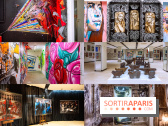
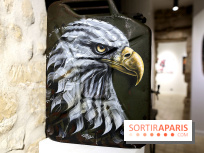
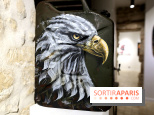
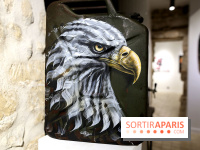
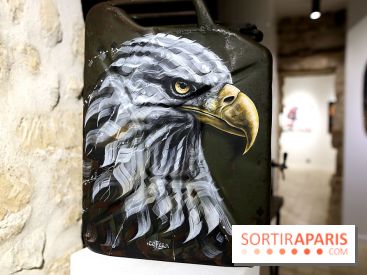
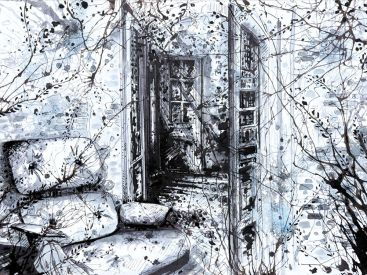
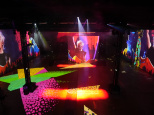
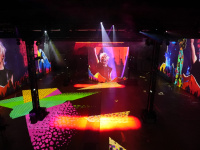
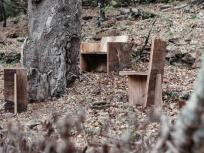
We spotted SAX’s color-splashed animals in the crypt of the Madeleine Church in June. This autumn they reappear in a quite different setting. The free exhibition “Imprints” lands at the Fondation Eugène Napoléon, in the 12th arrondissement of Paris, from October 29 to November 1, 2026.
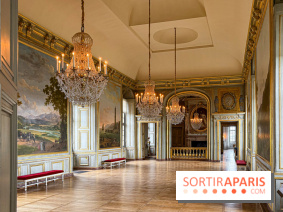
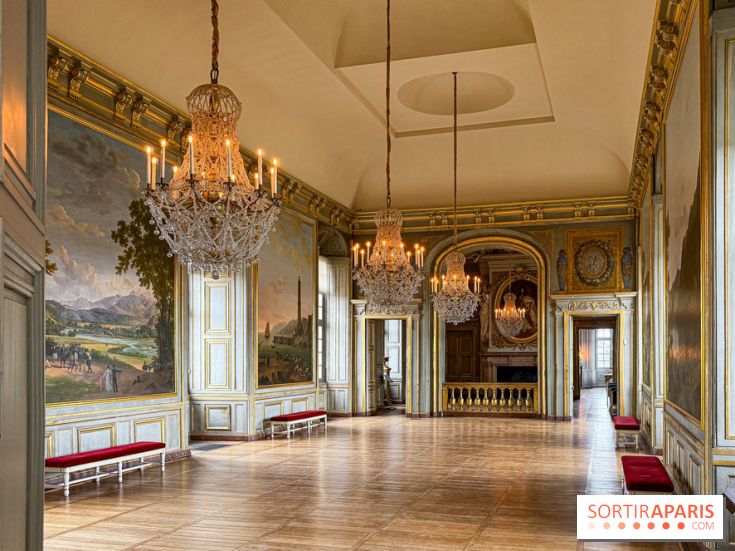
Painting, Land Art and photography will intersect there, inside 19th-century salons that the public hardly ever gets to see. Four days only, just a stone's throw from Place de la Nation.
Behind SAX stands Henry Blache, a street artist from the Drôme provençale. Presented by the Galerie Roussard, this exhibition caps a busy year for him: "La Caverne" at La Madeleine in June, followed by a monumental Land Art piece created at the foot of Mont-Saint-Michel this September, which drew more than a million views on Instagram.
The through line is the trace. The mark the brush leaves on the canvas, and the mark the artist plants in the landscape before the wind or the tide erases it. The exhibition has been conceived to celebrate the Mont-Saint-Michel’s ongoing adventure.
What’s on offer at this exhibition-sale:
A small, useful clarification: the photographs are not for sale. They serve as a memory of works that no longer exist, since these natural frescoes fade away under the elements, something that does not apply to the paintings and litos.
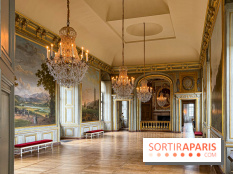
The tour starts right on the sidewalk, in front of the gates. Visitors then enter through the garden on the rue de Picpus side, before crossing the grand vestibule, the Salon de l'Impératrice, the narthex that precedes the chapel, and an upstairs meeting room. The chapel does not house artworks but remains open to visitors.
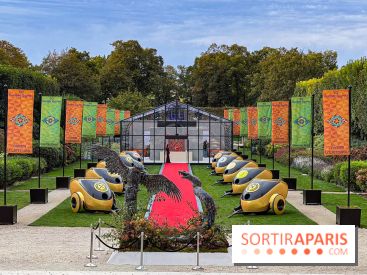
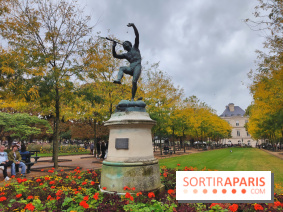
For the occasion, SAX unveils an on-site installation around the central statue of the inner garden, typically closed to visitors. It’s crafted from biodegradable materials, a landscape-like footprint in the sand that the next tide will wash away.
The best vantage point is from the balcony in the upstairs meeting room. From up there, you can take in the entire drawing, just as you would a fresco sketched on the sand.
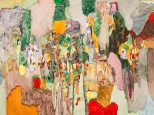
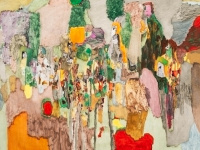
Emerging from street art, Henry Blache has since 2019 developed a painting style that is instantly recognizable. Spray cans, acrylics, ink or watercolors: he blends techniques and lets bursts of color gradually conjure a feline, a wolf, or a rhinoceros.
Since 2023, he has reconnected with the landscapes of his childhood and is creating large, ephemeral works outdoors from natural materials. The canvas remains his main playground, but it now engages with a second medium: the landscape itself.
Her story begins with a gift she refused. On January 26, 1853, the Paris City Council approved 600,000 francs to present a diamond necklace to Eugénie de Montijo, who would become Napoleon III’s wife. She declined and asked that the money be used to set up a free school for poor girls, as recalled by the Diocese of Paris.
The building was inaugurated on December 28, 1856, and it bears the name of the imperial couple’s son. In a touching wink, architect Jacques-Ignace Hittorff, who also designed the Cirque d’Hiver, gave it the shape of the rejected necklace—a detail that becomes evident from an aerial view.
Today, the venue still hosts schools and a women’s student residence. Only its street-facing garden is open to the public, which explains why so few Parisians have ever crossed the threshold. The building is, moreover, protected as a historic monument.
In 2026 the Foundation will mark its 170th birthday and begin restoring its historic heart. This exhibition, the first to be opened to the public on its premises, is also designed to raise its profile. An online fundraising campaign has been launched to support these efforts.
Galerie Roussard, founded in 1948 in Montmartre, long showcased Utrillo, Vlaminck, and Dufy before embracing urban art under the stewardship of Sophie and Julien Roussard. Since 2023, it has shed its walls to become itinerant, mounting exhibitions in venues rich with history.
SAX kicked off this new format with "The Five Elements" at La Madeleine in 2023, drawing more than 18,000 visitors. Its works are also on view on the gallery's site, French Art Collection.
Entrance is via the garden of Empress Eugénie, at 2 Rue de Picpus (Paris 12th). The public opening will take place on Thursday, 29 October 2026 from 6:00 p.m. to 10:00 p.m., with the artist in attendance. The exhibition will then be open for visits on Friday, 30 October from 11:00 a.m. to 8:00 p.m., Saturday, 31 October from 11:00 a.m. to 9:00 p.m., and Sunday, 1 November from 11:00 a.m. to 8:00 p.m. The entrée est libre et gratuite, sans réservation.
To reach it, Nation station (metro lines 1, 2, 6 and 9, RER A) is just a short walk away. The dates and times for the signings are announced as they come up on the gallery’s Instagram account @galerieroussard.
This outing speaks to both street-art enthusiasts and fans of animal portraiture, as well as to the curious about Parisian heritage. It’s a wonderful chance to push open a door that remains shut most of the year, and to see how an urban artist encounters the natural world.
Be aware that the window is brief—barely four days—during the Toussaint weekend. Some spaces will be closed to safeguard the Foundation’s activities. Daytime Friday is expected to be quieter than Saturday.
Want to extend your art-filled stroll? Take a look at our pick of street art exhibitions to discover in Paris and Île-de-France, or browse our guide to free October 2025 exhibitions in Paris. Right now, you can head over to the Expo des 150, where it’s unveiling several works.
Dates and Opening Time
From October 29, 2026 to November 1, 2026
Location
Eugène Napoléon Foundation
254 rue du Faubourg Saint Antoine
75012 Paris 12
Route planner
Prices
Free
Recommended age
For all