Cœur de Visites invites you this summer to guided tours at 10:30 a.m. and 2:30 p.m. through three neighborhoods: Montmartre, the Marais, and the Latin Quarter.
Why do some strolls linger in our memories while others fade within days of returning from vacation?
The answer isn’t only about the beauty of monuments.
It hinges on the way we look at them.
Paris is a city you can wander dozens of times and still not truly know. Every street, every façade, every square has a story waiting to be told. An old sign, a stone worn by the ages, a discreet door or a simple street name can become utterly fascinating once you uncover its origin.
That’s the magic of a guided tour in Paris: not about rushing through more sights, but learning to look, to lift your eyes, to notice a detail that thousands of passersby would miss, to hear the tale of a queen, an artist, a student, or a resistance fighter who, sometimes, continues to live on through the stones.
All you need is to know where to look.
That’s precisely what a passionate local guide provides: not just pointing out the must-sees, but teaching you how to read the neighborhood. And, little by little, the city reveals a new face: buildings stop being mere scenery and become silent witnesses to those who shaped Paris over the centuries.
Montmartre, the Marais, and the Latin Quarter are among the districts that best tell this story. Three neighborhoods, three atmospheres, three journeys through time.
And, above all, three different ways to fall in love with Paris.
Climb a few steps.
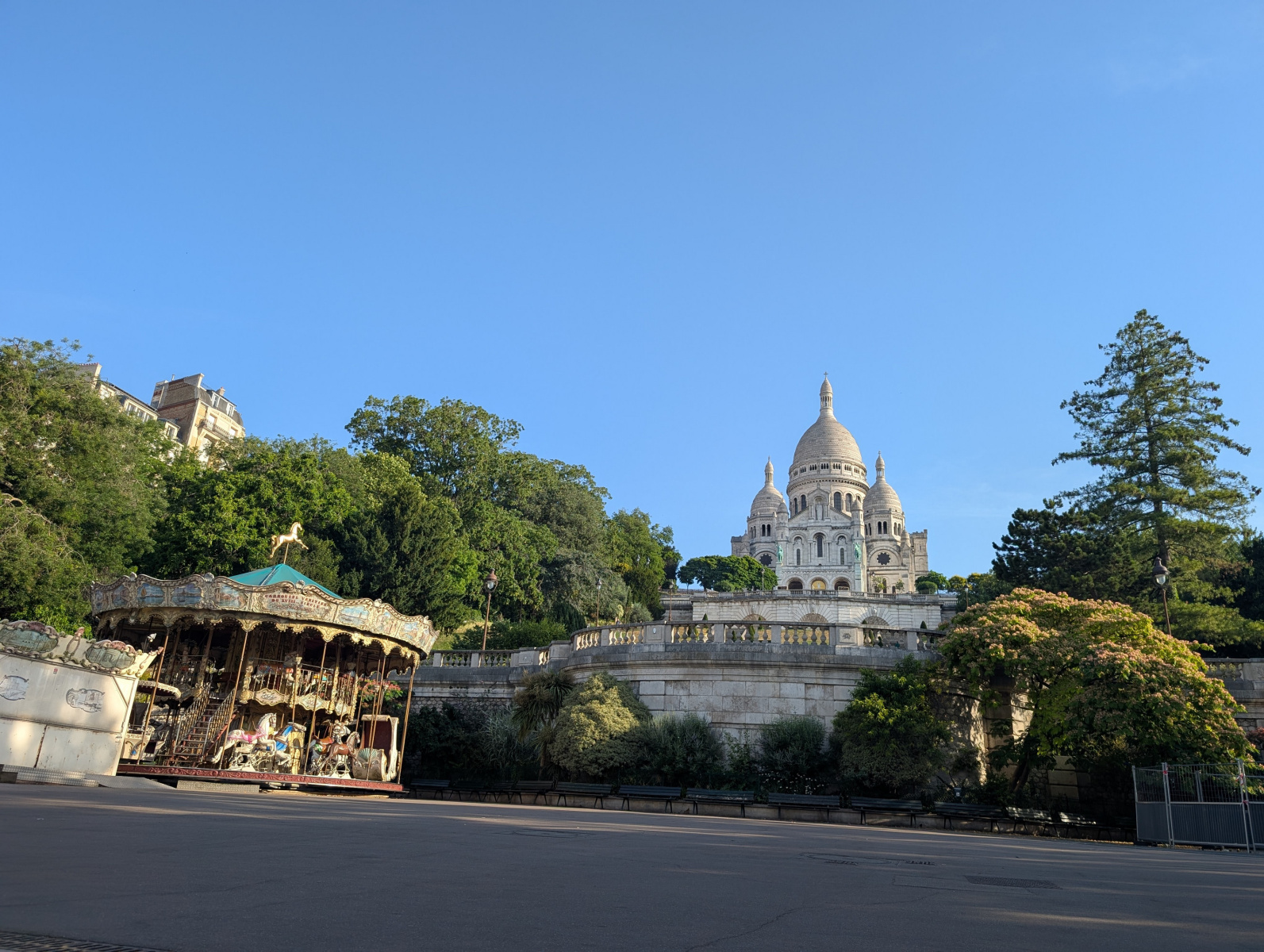
The clamor of traffic fades away. The grand boulevards give way to cobbled lanes, flower-lined stairways, and cottages that seem to have forgotten time. A cat strolls through a small square. An artist sets up his easel. Just beyond, the white silhouette of the Sacré-Cœur rises above the rooftops of Paris.
Only by stepping away from the busiest streets do you understand that Montmartre isn’t like other neighborhoods.
Here, you don’t just discover a monument or a panorama—you enter a village.
Before it joined Paris in 1860, Montmartre lived at its own pace. The Butte’s residents forged a strong identity and didn’t quite think of themselves as Parisians. It wasn’t unusual to hear someone ask on a street corner:
“Are we going down to Paris today?”
That expression may evoke a smile, but it captures the neighborhood’s history. From the top of the Butte, people didn’t say they were going to the city; they said they were descending into Paris. A reminder that Montmartre was then a separate village, ringed by gardens, windmills, gypsum quarries, and vineyards.
More than 160 years after its annexation, that village spirit remains. Step away from the Place du Tertre and wander down quieter lanes to rediscover a Montmartre that feels intimate, where locals still greet one another, where artist studios sit beside hidden gardens, and every turn yields a new surprise.
Few visitors realize that the famous Montmartre vineyards tell a story almost nine centuries old.
Tradition says the first vines were planted in the 12th century by Adelaide of Savoy, Queen of France and wife of Louis VI le Gros. Later she became the first abbess of Montmartre and is laid to rest today in the Church of Saint-Pierre in Montmartre, one of Paris’s oldest religious buildings, just a short walk from the Sacré-Cœur. Her memory remains vividly alive: a café on rue des Abbesses still bears her name.
The nuns of the abbey kept growing the vines for centuries. Today, the remaining rows along rue des Saules remind us that Montmartre was, before it became a painter’s enclave, a rural land. Each autumn, the Fête des Vendanges revives that tradition in a joyful, Botte-de-Butte spirit.
Then came the era of the artists.
At the end of the 19th century, affordable rents, bright studios, and a sense of freedom drew a remarkable cohort of painters, poster artists, writers, and cabaret songsters. Renoir, Van Gogh, Picasso, Suzanne Valadon, Maurice Utrillo, and Toulouse-Lautrec found endless inspiration here. They painted windmills, cabarets, gardens, locals, and that unique light that still enchants Montmartre’s lovers today.
Yet the neighborhood’s true charm isn’t only in its famous names.
It lies in the details.
In an old mill that recalls Montmartre once boasted about a dozen, in a tiny alley tucked behind walls draped in ivy, in a façade you might have passed without guessing that a world-famous artist once set up his studio there, or in a simple plaque that reveals a forgotten story.
That’s where the guided visit truly comes alive.
A local guide doesn’t just show you the highlights. They focus your gaze on what you’d likely miss on your own. They share anecdotes that spark smiles, those small details that shift your perspective on a neighborhood, and stories that linger long after you’ve left.
As you stroll, Montmartre sheds its postcard image and becomes a village again—a village where history, art, and daily life continue to meet at every corner.
That’s the experience offered by Cœur de Visites’ local guides. They know the Butte inside and out and relish sharing what they love most: the stories, the personalities, and the places that give Montmartre its singular character. Small-group tours foster conversation, questions, and camaraderie.
Want to discover the Montmartre of artists, vineyards, secret lanes, and little-known anecdotes? Find upcoming small-group tours at Montmartre-site.com.
Push open the heavy door of a grand townhouse. Beyond the arch, the city noise fades away. A paved courtyard unfolds before you. For a moment, it’s easy to forget we’re in the 21st century.
The Marais has that rare power: it makes time travel possible without leaving Paris.
Today the neighborhood draws visitors with its art galleries, cafés, designer boutiques, and lively atmosphere. But behind that modern buzz lies one of Paris’s most extraordinary historical witnesses. Here, every street tells a different era. Each façade preserves the memory of those who shaped the capital.
Its name already hints at its past.
Before becoming one of Paris’s most elegant districts, the Marais was, quite literally, a swamp. Over the centuries the land was drained, religious communities settled there, and noble families built sumptuous hôtels particuliers. In the 16th and 17th centuries the area became one of the capital’s most prestigious addresses.
Yet the Marais also holds delightful surprises for medieval Paris enthusiasts. Along a quiet side street, your guide may pause before an impressive stone rampart.
Few walkers imagine they stand before the most important surviving vestige of Philippe Auguste’s city walls. Built starting in 1190 to defend Paris before the king set off for the Third Crusade, the ramparts marked the city’s boundaries. More than eight centuries later, they endure.
That rampart predated Notre-Dame’s construction. It witnessed medieval knights, merchants from across the realm, and the first residents of a neighborhood that would become one of Paris’s most prestigious.
That’s the Marais’s magic: history isn’t locked away in museums; it reveals itself around a corner, behind a carriage gate, in a cobbled courtyard, or in a detail you might miss otherwise.
As you walk, perception shifts.
The grand townhouses stop merely being elegant buildings and become the homes of powerful families who shaped French history. Facades reveal Renaissance and Grand Siècle architectural styles. Inner courtyards show a way of life that time seems to have preserved.
The Marais is also a district of memory: memories of aristocracy who built its palaces, of Victor Hugo who chose the Place des Vosges as his home, and of old Paris whose medieval lanes somehow survived the centuries.
But the Marais is also a living district.
You’ll meet artisans, art galleries, bookstores, markets, buzzing terraces, and residents deeply attached to their neighborhood. It’s this constant meeting of heritage and everyday life that gives the Marais its distinctive character.
With a passionate local guide, the Marais reveals itself in a new light.
You don’t just discover an elegant quarter; you learn how nearly a thousand years of history continues to converse with today’s Paris.
That sensitive reading of the Marais is what Cœur de Visites guides offer. In small groups, they invite you to slow down, explore hidden passageways, step through carriage gates, notice the details that tell the centuries’ stories, and share the histories that give this exceptional neighborhood its soul.
Find the next Marais guided tours at www.maraisvisites.com.
Sit for a moment on a bench in the Square René-Viviani.
Around you, visitors instinctively look up toward Notre-Dame. Yet, right across is a small church that rarely catches the eye. More modest, more discreet, it is nonetheless one of Paris’s oldest religious buildings.
Welcome to Saint-Julien-le-Pauvre.
At first glance, nothing seems to disturb the place’s serenity. Yet approach its façade and you’ll see multiple bullet marks, still clearly visible. These scars aren’t marks of time; they testify to the fighting during Paris’s Liberation in August 1944, when the French Interior Forces, résistants, and German troops clashed here.
More than eighty years on, the stone still tells that story.
That’s the hallmark of the Latin Quarter. Here, every era has left its mark: the Romans founded Lutetia here, the medieval period gave rise to Europe’s most prestigious university, Enlightenment philosophers circulated ideas, students carried out grand intellectual debates, and resistants defended liberty.
Two thousand years of history seem to crowd into just a few streets.
But the Latin Quarter wouldn’t be the Latin Quarter without a woman whose memory still accompanies every walker.
As you climb Sainte-Geneviève Hill, you can’t miss the woman whose name the hill bears.
In the 5th century, as Attila’s Huns threatened Paris, Saint Genevieve urged the people not to abandon their city. Her courage, faith, and influence left an enduring mark on the capital’s history. Centuries later, an abbey was built in her honor on this very hill. Even today, her memory remains everywhere: Sainte-Geneviève Hill bears her name, and the church of Saint-Étienne-du-Mont preserves her former reliquary, a testament to the Parisian devotion she inspired for centuries.
At the top of the hill, the Panthéon now dominates the skyline. Nearby, students still frequent the amphitheaters, libraries, and bookshops that have long defined the neighborhood. It’s this academic tradition that gives the Latin Quarter its name. For centuries, students and professors from across Europe debated… in Latin.
This common tongue made the district the intellectual heart of the capital. Today that vibrancy remains. Terraces hum with conversation, bookstores overflow with books, cafés host students, researchers, writers, and travelers from all over the world. The Latin Quarter is truly alive.
Yet, as with Montmartre and the Marais, it’s often the details that tell the most beautiful stories: an old sign, a medieval façade, the remains of the Arenes de Lutèce where gladiatorial shows once rang out, a small church bearing the marks of Liberation, or a street name that recalls eight centuries of university life.
With a passionate local guide, these details suddenly make perfect sense.
You don’t merely discover a neighborhood; you understand how Paris became an intellectual, artistic, and spiritual capital whose influence has long crossed France’s borders.
That’s the journey through nearly two millennia of history that Cœur de Visites offers.
In small groups, the guides invite you to explore the Latin Quarter differently, to meet the great figures who shaped it, to observe the details you’d miss on your own, and to grasp why this district remains one of Paris’s most fascinating today.
Find the next guided tours of the Latin Quarter at www.quartierlatinvisites.com.
After these three strolls, one realization becomes clear.
Montmartre, the Marais, and the Latin Quarter are more than beautiful Parisian neighborhoods. They are three distinct ways to tell the story of Paris. But a city should never be reduced to its monuments.
What matters are the stories you uncover, the people you meet, and the emotions you feel, which turn a simple walk into a true travel memory.
At Cœur de Visites, we’re convinced heritage only comes alive when it’s shared with passion.
Cœur de Visites offers both small-group tours and private experiences.
That’s why our small-group tours are led by experienced local guides, chosen not only for their knowledge but also for their enthusiasm, hospitality, and ability to bring history to life.
Private tours are ideal for your private events (birthdays, hen/stag parties, etc.), for associations, companies, schools, and more—private tours are available on request.
We never forget a story that touches us. We remember the queen who planted Montmartre’s first vines nearly nine centuries ago, the medieval rampart we ran our fingers along in the Marais, the bullet marks still visible on Saint-Julien-le-Pauvre’s façade, silent witnesses to Paris’s Liberation, or Sainte Geneviève’s courage that urged Parisians not to abandon their city amid the Hun advance.
These stories don’t always appear in travel guides. Yet they’re often the ones that stay with you, giving a place its soul, bringing you closer to those who lived here before, and transforming a simple walk into a genuine encounter with Paris.
That’s the philosophy behind Cœur de Visites since its beginnings.
We believe a successful visit isn’t measured by the number of monuments seen, but by the looks that change, by those tiny details you’ll never view the same way again, by the anecdotes you’ll tell your loved ones that evening, and by the moments when you slow down, look up… and finally understand what you’ve had before your eyes all along.
Throughout the year, our passionate local guides welcome you to small-group tours in Montmartre, the Marais, and the Latin Quarter, in a friendly, warm, and engaging atmosphere.
Want to discover Paris at your own pace, with family, friends, or colleagues? Cœur de Visites also offers private tours across Paris, conducted exclusively by certified guides for a fully personalized experience.
So, whether you’re visiting Paris for the first time or already feel you know the capital well, let yourself be surprised.
The richest discoveries are often the ones you didn’t expect.
And sometimes, all it takes is a passionate guide to turn a stroll into a memory you’ll cherish for a lifetime.
Montmartre
www.montmartre-site.com
The Marais
www.maraisvisites.com
The Latin Quarter
www.quartierlatinvisites.com
Official website
www.coeurdevisites.com
Instagram page
@coeurdevisites
Booking
contact@coeurdevisites.com