On the 18th of September 1811, Napoleon I signed the decree that created the Paris fire brigade battalion. To fight fires in a capital growing ever more crowded, the Emperor made a radical choice: replace the old civilian organization of the fire guards with a professional corps under military discipline. A decision born from a catastrophe that had struck a year earlier, on a night when Napoleon himself narrowly escaped the flames.
Paris certainly didn’t discover firefighters in 1811. For a long time, the fight against fires relied on a variety of organizations, often backed by building tradesmen. A turning point came at the end of the 17th century with the emergence of more efficient fire pumps. In 1699, François Dumouriez du Perrier obtained the privilege to introduce new pumps to Paris, before a corps of fire guards was organized in 1716 under Louis XV.

A century later, the arrangement would reveal its shortcomings. The capital of the First Empire is dense, its streets are often narrow, the buildings still rely heavily on timber, and the means of fighting fire remain rudimentary. It is against this backdrop that, on July 1, 1810, the fire breaks out, a blaze that would upend the organization of the Parisian emergency services.
That evening, a lavish reception was hosted at the Austrian embassy, in the Hôtel de Montesson, on Mont-Blanc Street—today the Chaussée-d'Antin. The ambassador, the Prince of Schwarzenberg, celebrated the recent marriage of Napoleon I to Archduchess Marie-Louise of Austria, a union aimed at sealing the rapprochement between two powers long sworn enemies.

To host several hundred guests, a vast temporary ballroom was erected in the garden. Wood, fabrics, drapes, gauze, artificial flowers: the decor is spectacular, but highly flammable. Hundreds of candles and lights illuminate the celebration. Over the course of the evening, a drape caught fire. The flames spread quickly to the ceiling and then to the entire structure. Panic erupts as guests scramble to flee while the fire devours this ephemeral architecture in minutes.
Napoleon and Marie-Louise manage to escape, but several people perish in the blaze. Among them is Pauline d'Arenberg, princess of Schwarzenberg, sister-in-law to the ambassador, who is said to have returned to the room in search of one of her daughters. The exact toll has long been the subject of conflicting accounts, some testimonies having amplified the number of victims, but the catastrophe is enough to spark a scandal.

But Napoleon isn't just pursuing the causes of the blaze; he wants to understand why the relief services were so ineffective. The inquiry ordered after the tragedy highlights the weaknesses of the Parisian organization: failing command, insufficient discipline, mediocre preparation, and imperfect coordination. The fire brigades present on the night of the blaze are not directly held responsible for the catastrophe, but the overall functioning of the corps is seriously called into question.
For Napoleon, the answer lies in a framework he knows better than anyone: the army. The first reorganization arrives in 1811, with the deployment of Imperial Guard engineering sappers to safeguard the imperial residences. And then comes the decisive reform.

On September 18, 1811, an imperial decree officially creates the Paris Fire Brigade battalion. The civilian fire guards disappear in favor of a permanent military formation. The new corps is placed under the authority of the police prefect, an institutional feature that remains at the core of the organization of the Paris firefighters more than two centuries later.
The battalion is organized into four companies, each responsible for a section of the capital. The men are now under a chain of command, subjected to training, and bound by the rules of the military discipline. The goal is no longer simply to assemble men who can wield a pump when the fire breaks out: there must be a standing, trained force that can be mobilized immediately.

This militarization is one of the defining peculiarities of the Parisian firefighters. In most French cities, fire services follow different models. In Paris, the dense population, the concentration of political power, and the capital’s strategic importance justify, in the regime’s view, a distinctive organization.
The word "sapeur-pompier" itself captures this double origin. The "pompier" handles the pumps used to deliver water to the fire; the "sapeur" points to the military engineers, whose men know how to clear passages, cut through obstacles, and work on buildings. In the face of major urban blazes, it was sometimes necessary to demolish a structure to stop the flames from spreading to neighboring houses.

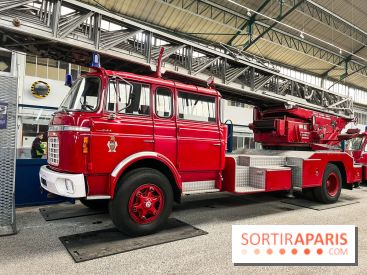
The creation of 1811 obviously did not give birth to the brigade as we know it today. Equipment, vehicles, communications and intervention methods will undergo profound changes throughout the 19th and 20th centuries. Manual pumps will give way to steam pumps and then to motorized apparatus; warning devices and telegraphs will progressively replace messengers; ladders, breathing equipment and rescue techniques will transform the trade.
The institution itself grew with Paris. On December 5, 1866, as Haussmann's Paris had expanded considerably, the battalion became the Paris Firefighters Regiment. A century later, on March 1, 1967, the regiment took the name of the Paris Firefighters Brigade, the BSPP.

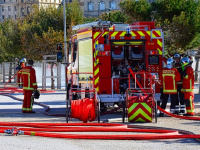
The principle laid down by Napoleon remains strikingly stable: the Paris fire service is still made up of military personnel from the French Army, employed under the authority of the police prefect. Their remit, however, has extended well beyond the boundaries of 1811 Paris, and today it covers not only the capital but also the Hauts-de-Seine, the Seine-Saint-Denis and the Val-de-Marne.
To go further:
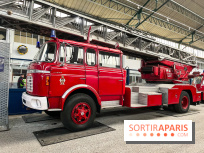
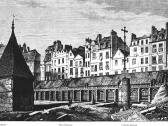
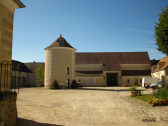
Immerse yourself in the history of the Paris fire department, at the dedicated museum in Saint-Ouen (93).
If you didn't already know, the town of Saint-Ouen-sur-Seine (93) has a museum dedicated to the fire department: open only a few times a year, or on guided tours, it's a place of remembrance for the whole family to discover. [Read more]
This page may contain AI-assisted elements, more information here.
Dates and Opening Time
On September 18, 2026
Location
Paris Fire Brigade Museum
89 Rue du Docteur Bauer
93400 Saint Ouen
Route planner





























 Immerse yourself in the history of the Paris fire department, at the dedicated museum in Saint-Ouen (93).