We’re watching the sky like we’d watch for good news. The heatwave keeps Paris and Île-de-France on high alert this Monday, July 13, 2026, with no fewer than 37 departments under red alert and 46 under orange, in a zone whose northern tip reaches Val-d'Oise (95). Île-de-France itself is also placed under yellow thunderstorm vigilance, but to be clear: no significant rain is forecast for the region in the near term. The risk mainly involves isolated storms—scanty in rainfall—and thus particularly dangerous in dry conditions.
According to Météo-France, the heatwave is expected to persist at least until midweek, gradually shifting eastward. On Tuesday, July 14, the Île-de-France region still tops 35°C: the Fête nationale unfolds under oppressive heat, with numerous annulations de feux d'artifice and bals des pompiers already announced.
The real tipping point is expected from Wednesday, July 15. The lull begins in the West, with thunderstorms moving in during the afternoon over Normandy, Île-de-France, and the Centre-Val de Loire. On Thursday 16 and Friday 17 July, the storms and showers spread across the entire country, and temperatures finally start to drop (from 32–35°C on Thursday to 26–31°C on Friday). Nothing is set in stone yet: depending on whether the storms blow in a bit earlier or later, the relief could shift by a day or two.
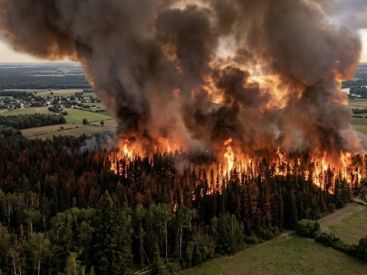
Water shortages aren’t just written on brown lawns. In Seine-et-Marne (77), a fire of unprecedented scale broke out Sunday, July 12, in the late afternoon along the A6 and spread into the Forest of Fontainebleau. By Monday morning, July 13, more than 800 hectares had burned, with the blaze impacting the towns of Achères-la-Forêt, Arbonne-la-Forêt, Le Vaudoué and Noisy-sur-École.
About 500 firefighters are on the scene, supported by water-bombing planes and helicopters — a first for the Paris region. Some 900 people have been evacuated, with no homes affected and no injuries reported so far. Interior Minister Laurent Nuñez cited around ten fires and a suspected deliberate ignition, with an investigation underway. Rescue services expect to remain deployed for one to two weeks. Traffic on a stretch of the A6 has been halted: before any southbound travel, a check of Bison Futé is advisable.
The expected storm rain won’t fix things. It comes down fast and hard on ground baked like concrete: water runs off instead of seeping in, and the floods hardly benefit. After a winter and spring that were drought-stricken, the region is starting from well behind.
Water restrictions are multiplying, then. In the Yvelines (78), the Seine basin has been under a drought alert since July 2, 2026, with limits in more than a hundred municipalities, from Mantes-la-Jolie to Versailles. In the Val-de-Marne (94), the prefect has placed the Réveillon and Morbras basins in crisis on July 6, 2026, with stringent measures for twelve southeastern communes (Boissy-Saint-Léger, Sucy-en-Brie, Villecresnes...). In Seine-et-Marne (77), a new decree was signed on July 7, 2026, and the regional prefecture has placed the entire territory under drought vigilance.
Watering, filling pools, and washing cars: rules vary from one municipality to the next, and non-compliance can bring fines of up to €1,500. To know precisely what applies where you live, the official site VigiEau remains the reference, address by address. As we await the first showers, the habit stays the same: check the Météo-France vigilance map every morning, avoid forested areas, never discard cigarette butts, and during the hottest hours retreat to the region’s cool pockets.
Recommended age
For all