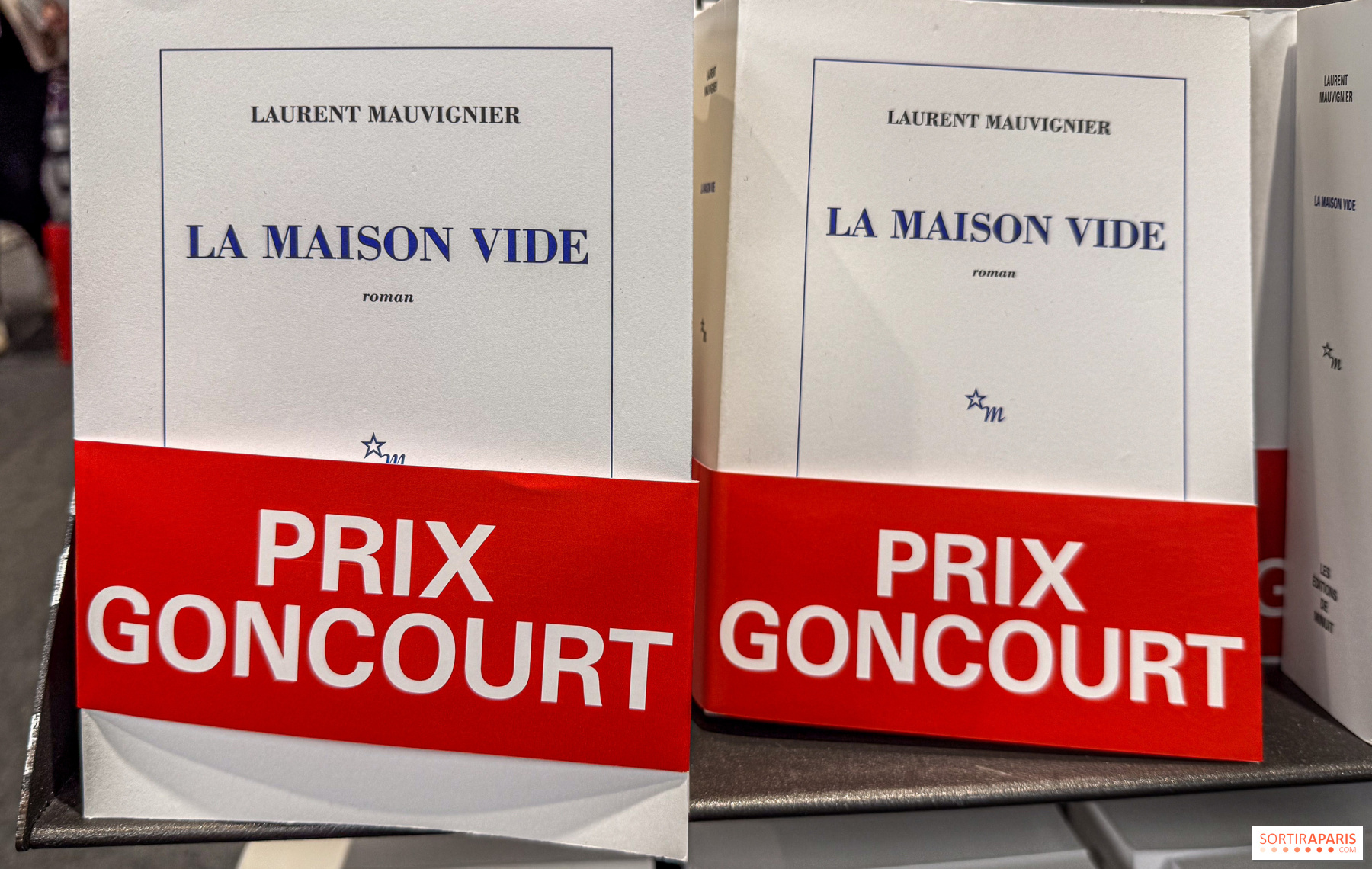
Following Kamel Daoud last year , the2025 Prix Goncourt has just honored Laurent Mauvignier for his impressive family saga La Maison vide, published by Éditions de Minuit. On Tuesday, November 4, the ten Goncourt academicians, gathered as is tradition at the Drouant restaurant in the Opéra district of Paris, elected the author from Tours in the first round of voting. It was a decisive victory, with 6 votes to 4 for Belgian novelist Caroline Lamarche and her novel Le Bel Obscur. The writer thus succeeds Kamel Daoud, winner of the 2024 prize for Houris.
In this 750-page saga, Laurent Mauvignier delves into his own family history, tracing it back through the generations. It all begins in 1976, when his father reopens a mansion in Touraine that has been closed for twenty years. Inside, there are a few objects that bear witness to the past: a piano, a chest of drawers with chipped marble, a Legion of Honor medal, and, most notably, family photographs in which the face of his grandmother Marguerite has been systematically cut out with scissors. This mysterious erasure triggers a dizzying literary investigation.
The author goes back in time to the end of the 19th century to understand what happened in this house. He brings Marie-Ernestine, his great-grandmother, back to life, a promising young pianist whose dreams of attending the Paris Conservatory were shattered by an authoritarian father. Then there is Jules, her husband, who was killed as a hero at Verdun in 1916. And finally Marguerite, who was shorn of her hair at the Liberation for her alleged links with the German occupiers. So many destinies shattered by the violence of the century, the two world wars, and the weight of family secrets. This family saga spans three generations and attempts to understand how these traumas were passed down until the writer's father committed suicide in 1983, when the writer was only 16 years old.
Philippe Claudel, president ofthe Académie Goncourt, praised the career of this author, who has been with Éditions de Minuit since 1999, in front of the press: "We are paying tribute to an author who already has a very important body of work behind him and who, this year, has given us not a collection, but a novel that is nonetheless fundamental." This is a tribute to a writer who has been building his body of work for more than 25 years, with notable novels such as Des hommes sur la guerre d'Algérie (Men on the Algerian War) and Histoires de la nuit(Stories of the Night), his previous suspense novel that already foreshadowed La Maison vide (The Empty House) in a few pages. More information about the author is available on his official website.
Born in Tours on July 6, 1967, into a working-class family from Descartes, Laurent Mauvignier first studied fine arts at the École des Beaux-Arts in Tours before devoting himself entirely to writing. His first novel, Loin d'eux(Far from Them), published in 1999, won him the Prix Fénéon. Since then, he has received numerous awards: the Prix Wepler and Livre Inter for Apprendre à finir, the Prix du roman Fnac for Dans la foule, and the Prix des libraires for Des hommes. In 2015, he received the Grand Prix de Littérature de la SGDL for his entire body of work. His style is characterized by long, winding sentences that delve into the psychology of his characters and explore the dark corners of the human soul.
Even before the Goncourt announcement, La Maison vide had already received several major awards: the Le Monde literary prize, the Landerneau readers' prize, and the Nancy booksellers' prize. Nearly 82,000 copies of the novel had been sold before the prize was announced, a figure that is expected to skyrocket in the coming weeks thanks to the famous red banner.
Contrary to what one might imagine, the Prix Goncourt brings its winner only a symbolic €10. This paltry sum dates back to the prize's creation in 1903 and has never been reevaluated. At the time, this sum was already considered a purely honorary reward. But make no mistake: while the check may be modest, the benefits are enormous. The Prix Goncourt remains the most prestigious literary award in the French-speaking world and guarantees the winner sales in the hundreds of thousands, or even over a million copies. The famous red band on the cover of the book acts as a real magnet for the general public and propels the work to the top of the sales charts for months. For Laurent Mauvignier and Éditions de Minuit, this is therefore a major literary recognition, but also a considerable economic windfall.
The ten judges ofthe Académie Goncourt all wore badges in support of Algerian writer Boualem Sansal, currently imprisoned in his country, demonstrating their commitment to freedom of expression. Other finalists included Emmanuel Carrère for Kolkhoze and Nathacha Appanah for La nuit au cœur, the latter having won the Prix Femina the day before.
Alongside the Goncourt, the Renaudot Prize was awarded to Adélaïde de Clermont-Tonnerre for Je voulais vivre, published by Grasset, while the Renaudot Essay Prize went to Alfred de Montesquiou for Le crépuscule des hommes, published by Robert Laffont. It was a great day for French literature, confirming the vitality of contemporary novel writing.
With this 2025 Prix Goncourt, Laurent Mauvignier joins the very select circle of great French authors honored by this distinction, created in 1903. His novel La Maison vide stands out as one of the major works of this fall's literary season, carried by a rich and sensitive writing style that brings the invisible figures of history back to life. A literary monument that explores the transmission of family trauma and poses this dizzying question: how do the wounds of the past continue to shape us, several generations later?
This page may contain AI-assisted elements, more information here.