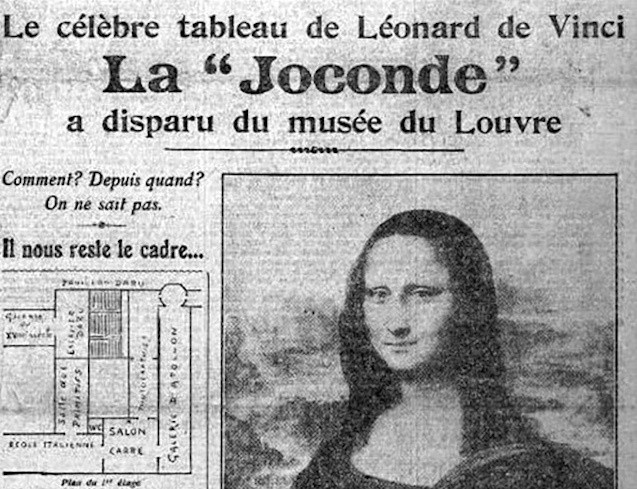
On Tuesday August 22, 1911, the Mona Lisa was stolen from the Musée du Louvre under everyone's noses. In the early hours of the morning, painter Louis Béroud, accompanied by engraver Frédéric Laguillermie, went to the Salon Carré of the Louvre. The two artists, both regulars, were planning to sketch, as usual, a painting on display in the museum.
They decide to see Leonardo da Vinci's Mona Lisa. But when they arrive at the spot where the Italian painting is usually displayed, the two friends are forced to face the facts: the Mona Lisa has disappeared! When notified, the guards initially assume that the work has been moved by the curators and is inthe Braun & Cie photographic reproduction studio, located within the Louvre itself. But the painting is not there.
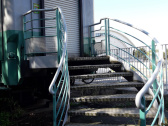
Alerted, the Sûreté Parisienne arrived on the scene in the early afternoon. Nearly 60 inspectors, led by Commissaire Divisionnaire Octave Hamard, were assigned to investigate this incredible disappearance. The fingerprints of 257 museum employees were taken to compare with those found by Alphonse Bertillon, criminologist and father of the first criminal identification police laboratory, on the frame and glass pane of the painting discovered in the small staircase leading to the Cour Visconti. But to no avail.
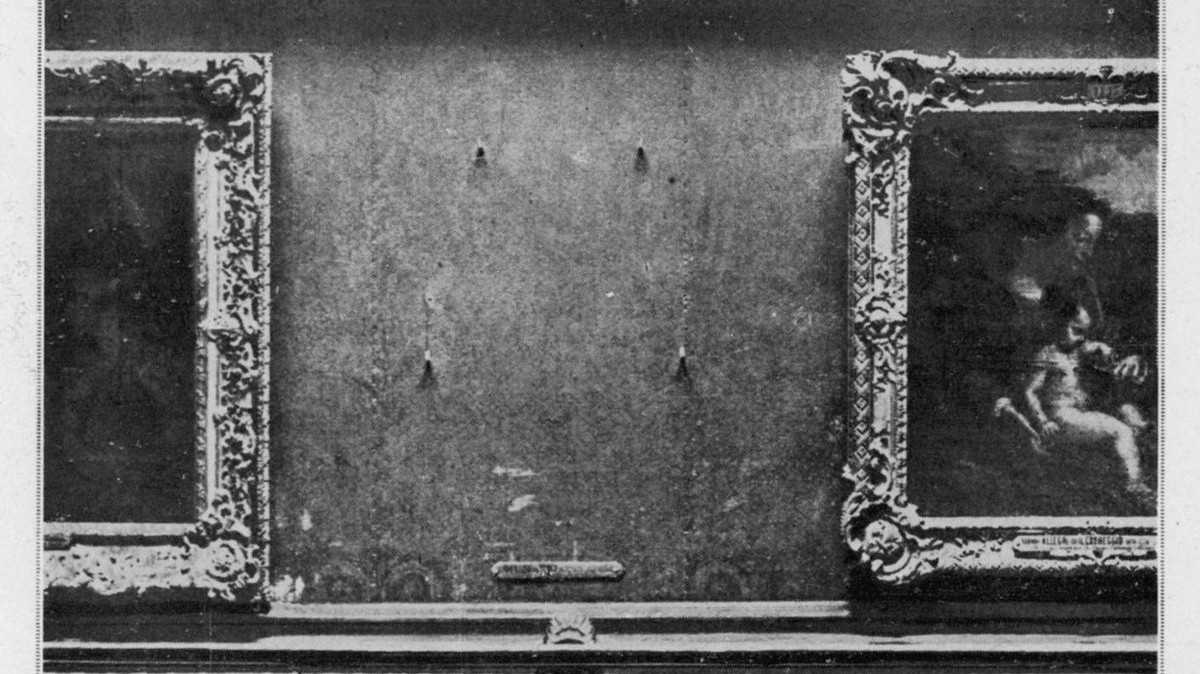
As the investigation stalled,public opinion went into overdrive, incriminating in turn the mismanagement of the Louvre, the inattention of the guards and the indifference of the public authorities. Théophile Homolle, the director of the Louvre, was forced to resign, while the investigating judge in charge of the case, Joseph-Marie Drioux, directed his wrath at everyone, to the point of suspecting and imprisoning Guillaume Apollinaire in the Santé prison from September 7 to 11.
The poet had already been implicated in the theft of three Phoenician statuettes from the Louvre in 1907 and 1911 by his private secretary and friend Géry Pieret, who then sold one to Apollinaire and two to Picasso. Picasso, who later claimed to have known nothing of the fraudulent provenance of the statuettes that inspired Les Demoiselles d'Avignon, was himself suspected of complicity in the Mona Lisa theft before being cleared, as was Apollinaire.
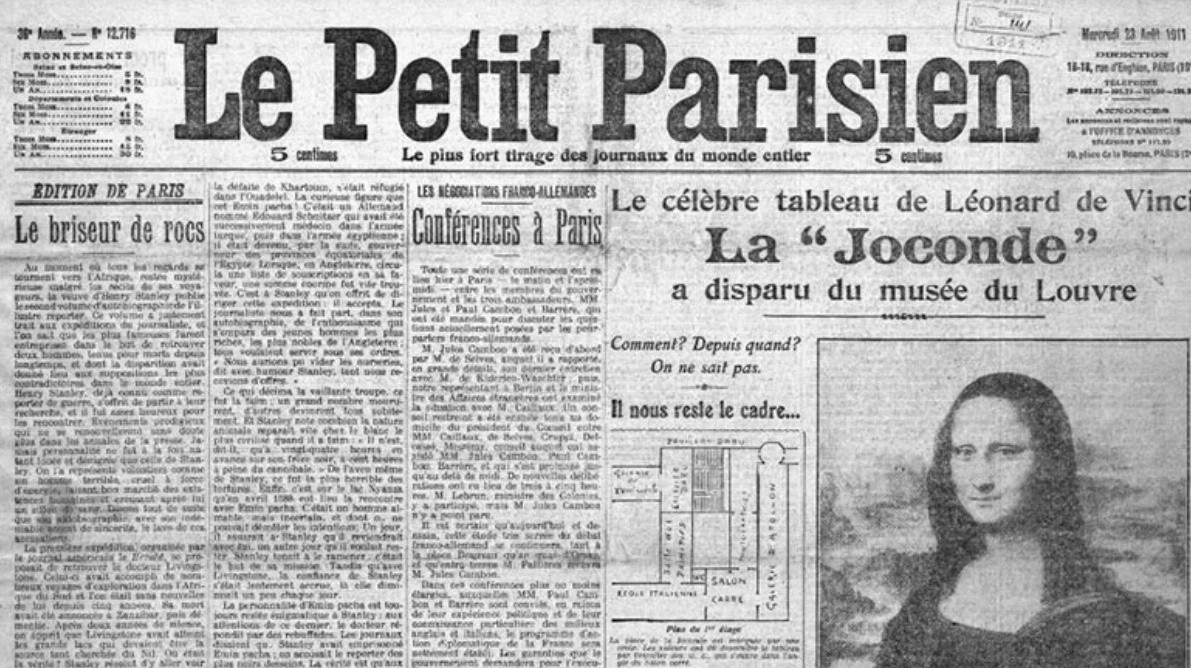
For two years, the French and international press were fascinated by the police investigation and speculated about the motive for the theft. The Society of Friends of the Louvre offered a reward of 25,000 francs to anyone who returned the masterpiece. The magazine L'Illustration offered double that amount, 50,000 francs, to anyone who brought the famous painting back to its offices. Nothing worked; after 28 months of investigation, the Mona Lisa was still missing.
However, since the forfeit, Mona Lisa has been in Paris, hiding in an apartment on rue de l'Hôpital Saint-Louis, in the capital's working-class 10th arrondissement.
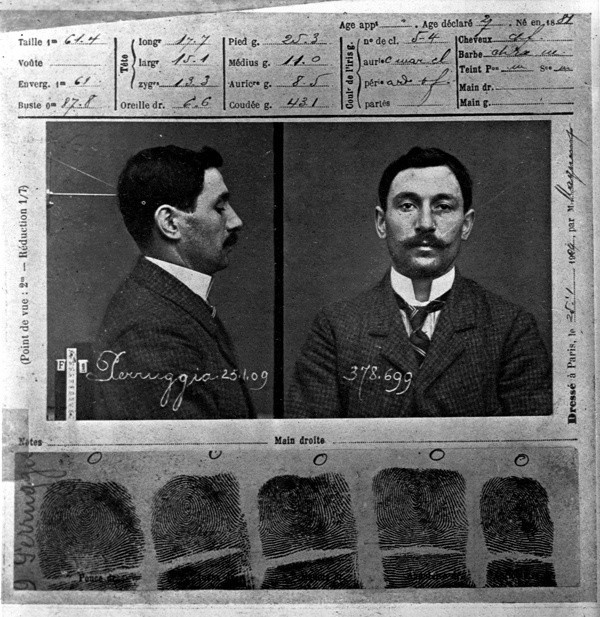
On December 10, 1913, the thief showed up in Italy: he tried to sell the painting to a Florentine antique dealer, Alfredo Geri, under the name of Leonardi, for 500,000 lire. Alfredo Geri and Giovanni Poggi, director of the Uffizi Museum, alerted the Carabinieri, who arrested the thief in his Florence hotel, confirming that the painting was indeed the one that had been sought after around the world for 2 years .
The thief, Vincenzo Peruggia, was an Italian glazier who worked at the Musée du Louvre. Perfectly familiar with the premises, he waited until the museum closed on the evening of August 21, 1911, to hide the masterpiece under his white employee's coat. Questioned by the police in the early days of the investigation, he came up with an alibi that was accepted by the Sûreté inspectors. As to the reasons for his theft, he confessed that he had stolen the Mona Lisa out of patriotism, in order to return it to Italy.
"Often, while I was working in the Louvre, I would stop in front of da Vinci's painting, and I was humiliated to see it like this in a foreign land. Stealing it was very simple. All I had to do was choose the right moment. One morning, I joined my fellow decorators at the Louvre, exchanged a few words with them, then entered the salon where the painting was hanging. It was deserted. The painting was smiling at me. In an instant, I had unhooked it from the wall. I set the frame down on the stairs and slipped the panel under my smock. It was done in seconds. No one saw me, no one suspected me", he declares in his first statement.
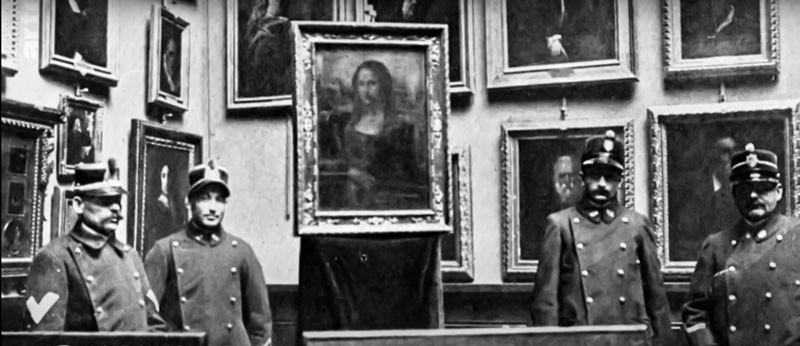
He maintained this line of defense throughout his trial , which took place in Italy, as the accused had not been extradited. Supported by many Italians, the court, charmed by his patriotism, sentenced him to just one year and fifteen days in prison, a sentence later reduced to seven months. After a successful tour of Italy, the Mona Lisa returned to the Louvre Museum on January 4, 1914, where it has since been exhibited under close guard.
If you feel like seeing (or seeing again) the mysterious smile of Mona Lisa, she is located in the Salle des Etats, on the first floor ofthe Denon wing of the Louvre Museum. This is also an opportunity to discover the current exhibitions: Paris-Athens, Pharaoh of the Two Lands and On Stage!
Location
Louvre Museum
musée du louvre
75001 Paris 1
Access
Metro Palais Royal - Musée du Louvre