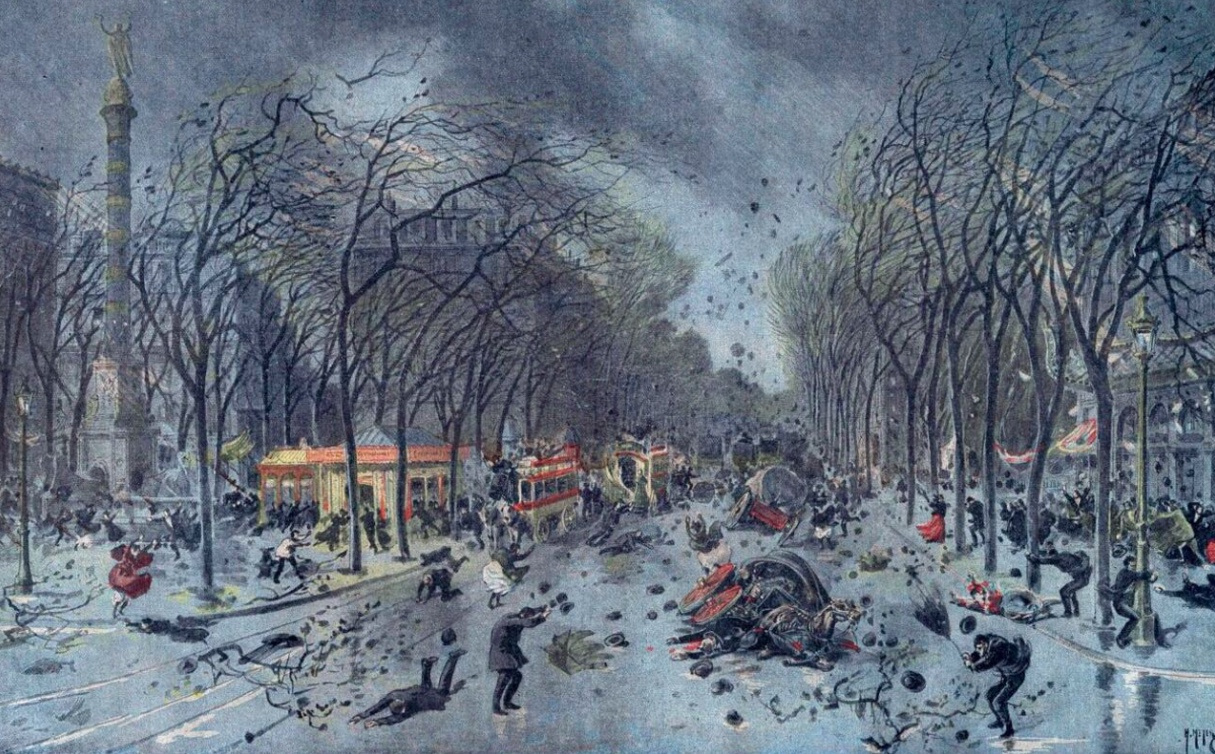
On Thursday, September 10, 1896, a natural and meteorological phenomenon of unprecedented scale and ferocity struck the streets of the capital. This tornado, the first—and last—to ever cut across Paris, caused extensive property damage and the deaths of five people along its path from Place Saint-Sulpice to Parc des Buttes-Chaumont.
For several weeks now, Paris and the Ile-de-France region have been battered by violent thunderstorms, culminating on July 26, 1896 in a particularly severe hailstorm affecting the Montsouris and Belleville districts, as well as the Bois de Vincennes and the Bois de Boulogne. The storm uprooted trees, ravaged flowerbeds, ripped off roofs and smashed shop windows; streetcar traffic was disrupted by fallen tree trunks.
Two Parisian women, a little girl of eleven and a woman in her twenties, lost their lives, the first in the collapse of a washhouse in the 13th arrondissement, the second from a fall from the top of the fortifications at the Porte d'Ivry. But what Parisians thought would be the climax of the bad weather ofsummer 1896 was not, in fact, reached.
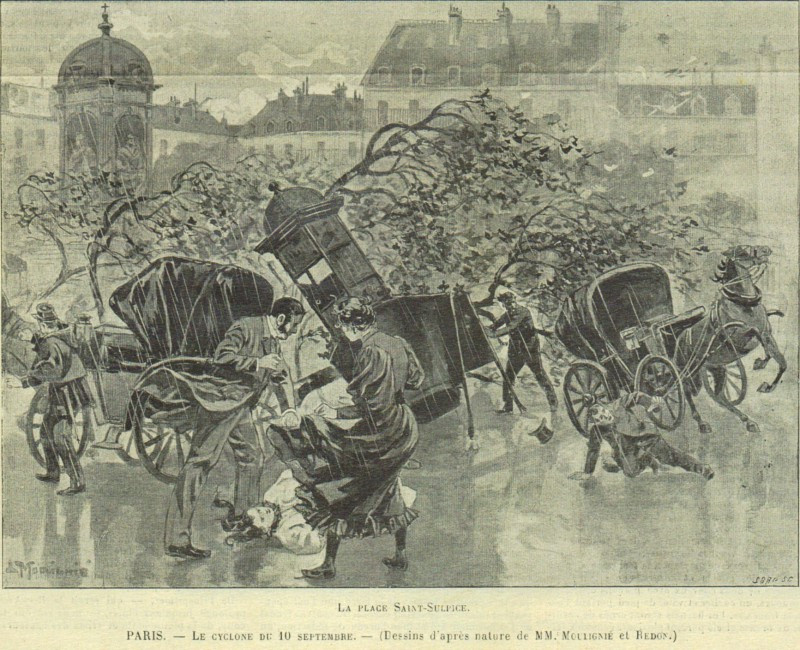
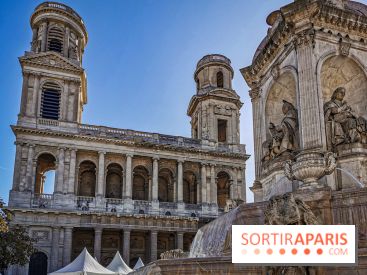
On September 10, 1896, just before 3 p.m., Paris is once again struck by a storm, but this one quickly takes a far more terrifying and dramatic turn than its predecessors. In the heart of the 6th arrondissement, between the north end of the Jardin du Luxembourg and the Place Saint-Sulpice, a tornado forms before the astonished eyes of the passersby.
With gusts of up to 220km/h, this category EF2 tornado on the Fujita scale is moving in a straight line towards the north of the capital, through the 6th, 1st, 3rd, 10th and 19th arrondissements. It crossed the Place Saint-Sulpice, took the Quai des Grands-Augustins , where trees were uprooted and books scattered to the four winds, crossed the Seine, where several damaged barges ended up sinking, and reached the west of theIle de la Cité via the Pont-au-Change.
On the right bank, the tornado, which averaged 300 meters in width, continued its devastating path, reaching the Place du Châtelet, where it tore off the roof of the theater, passed in front of the Tour Saint-Jacques, where it decapitated a gargoyle, climbed the Rue Réaumur and then the Rue de Turbigo, before reaching the Place de la République. But the phenomenon doesn't stop there!
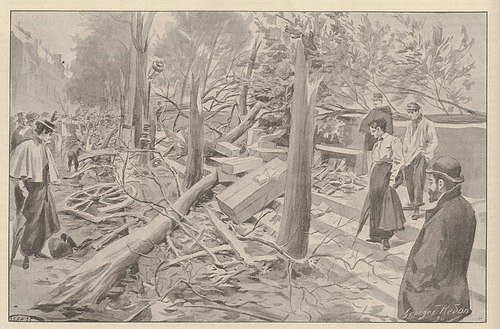
It then moved on to boulevard Saint-Martin, boulevard de Magenta and the canal Saint-Martin, where a woman and her child were thrown into the water. The tornado finally ended its run on boulevard de la Villette, passing through the Buttes-Chaumont park, but not before wreaking havoc on a nearby funfair.
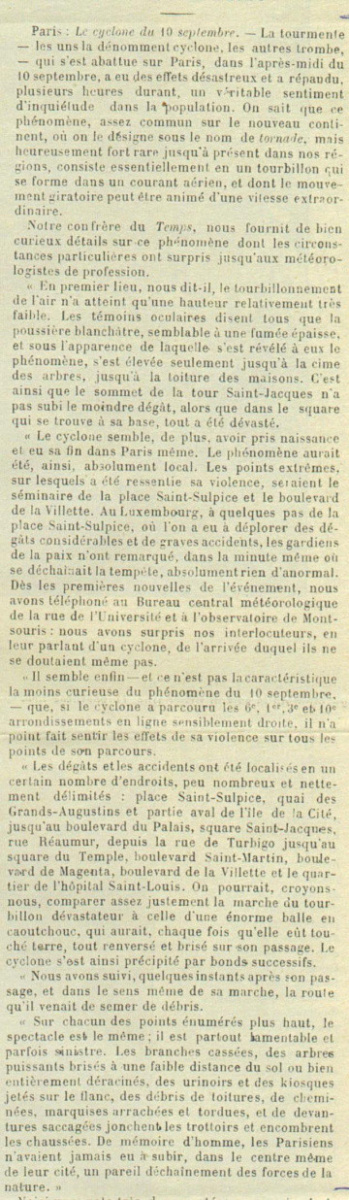
In just 3 to 4 minutes, the column crossed Paris from southwest to northeast, covering 6.3 kilometers and sweeping everything in its path. Chestnut, elm and plane trees were smashed, roofs and lampposts were torn off, and an omnibus was even lifted up and overturned on the sidewalk by the force of the wind, as were numerous carriages.
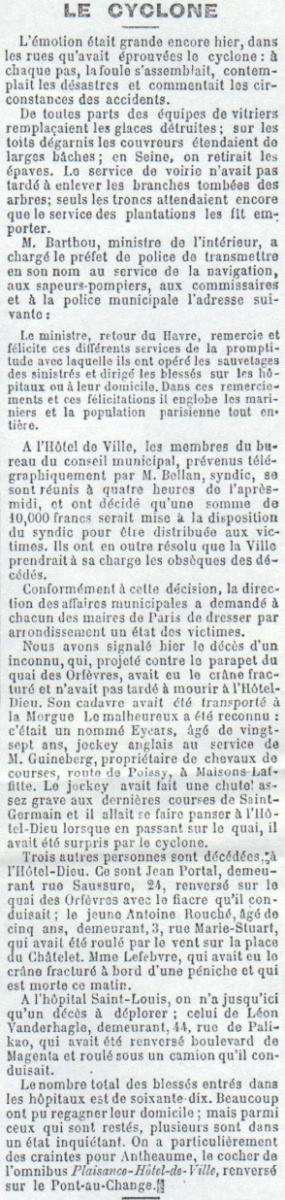
But the dégâts matériels are not the only misfortunes to report: nearly 70 Parisians are seriously injured and 5 people lose their lives, dying from contusions and skull fractures, including an English jockey named Eyears, a 30-year-old coachman, Jean Portal, thrown from his fiacre, Léon Vanderhagle, a laborer crushed by a 300 kg lead plate that fell from a roof or, depending on the version, toppled onto the Boulevard Magenta, as well as Antoine Rouché, a five-year-old boy, lifted by the force of the wind and hurled against the parapet of Pont-au-Change.

The very next day, the municipality organizes the nettoyage des rues of Paris and unlocks 10,000 francs for the victims' funerals, while the newspapers seize on the story and collect statements from witnesses to the phenomenon. Those headlines must have surprised many Parisians!
In fact, despite its violence, the tornado only affected a tiny part of the capital. Le Figaro was astonished by this in its September 11, 1896 edition: "The curious thing is that during this time, in Montmartre, in the ninth arrondissement, on the Champs-Elysées, on the Champ-de-Mars, no one suspected that a terrible cyclone was wreaking havoc in Paris. It rained, and that was that. By four o'clock, the cyclone had passed. The sky was clearing. The rain stopped altogether."
Dates and Opening Time
On September 10, 2026
Location
Place Saint-Sulpice
Place Saint-Sulpice
75006 Paris 6
Route planner
Accessibility info
Booking
View the prices of this ticketing service
More information
Iconographies: Header: RUE DES ARCHIVES/PVDE Cyclone formation, place Saint-Sulpice. Life drawing by MM. Mouligné and Redon Les quais de Seine, après le passage de la trombe, engraving by Georges Redon La tornade du 10 septembre 1896 Period press clippings reporting the event