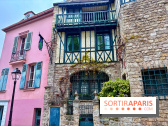
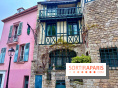
In Paris, the famous walled windows are not an architectural mystery, but the result of a tax ploy based on a former window tax introduced in 1798. An unusual anecdote that tells of a time when breathing was almost a luxury... and when taxes were even imposed on your curtains.
This is the story of the absurd tax on doors and windows! After the Revolution, in 1798, the Directoire introduced a tax on openings - doors and windows - to the exterior. The idea was simple: the more openings you had, the more you could afford to pay. So every opening visible from the outside was taxed.
The more windows you had, the more you paid. A real invitation to live in the dark. Parisians, never short of tricks, didn't let themselves be blinded. Fewer windows, lower taxes. Implacable logic. Quickly, we plug up, we wall up, we camouflage. Some opted for the rustic method: good old-fashioned trowel walling. Others, more subtle, prefer trompe-l'œil, painting false windows to keep the facades in harmony. The taxman will be delighted - and you, a false balcony.
And that's how Paris ended up with facades full of fake windows, also known as "tax windows". Some are painted in trompe-l'œil, others are simple openings doomed forever. The idea wasn't just to save money: the symmetry of the Haussmann façades, so dear to the architects, also had to be preserved. We didn't want a wobbly façade, even if we were angry with the taxman.
Old-stone enthusiasts were in for a treat: mullioned windows, divided into several sections, counted as four openings! The verdict was clear: an architectural style could cost you an arm and two eyes.
Of course, all this has its side-effects: by dint of hiding light, we end up ruining our health. Fewer windows mean less air, less hygiene and more disease. As early as the 19th century, doctors got involved, denouncing a tax as obscure as its consequences. It wasn't until 1926 that it was finally abolished. Phew, we could finally open our windows without having the taxman on the balcony.
And no, Paris was not alone in this shadow play. The whole of France was entitled to it, from the most modest country house to the most noble townhouse. And this brilliant idea was not only French: in Great Britain, the famous "window tax" was introduced in 1696 and abolished in 1851, also leaving behind blind facades. Belgium, the Netherlands and Spain also succumbed to the temptation to tax light. It would seem that, in those days, seeing clearly was a... fiscal privilege.
This page may contain AI-assisted elements, more information here.