Some people grimace at the thought of eating them. For others, it's a prospect that arouses curiosity. And for still others, it's an indulgence that's nothing out of the ordinary. Why would the French eat snails?
It's a question that tickles the fancy of many foreigners - and even some French people! Let's face it: for many, the idea of tasting a terrestrial mollusc with a shell is more reminiscent of a reality TV challenge than a festive dish. And yet, in France, snails are served on special occasions, topped with parsleyed butter, with a very precise ceremonial.
So how did a slow, slobbering animal conquer French taste buds and become anicon of French gastronomy? To find out, we need to go back... far, far back. From archaeological digs to diplomatic banquets, let's embark on a story that's as tasty as it is unexpected.
Where to eat good snails in Paris? Our best addresses
Here are the best places to try one of the most famous dishes in French cuisine: escargots en persillade. [Read more]
In Provence's Huveaune valley, shells eaten over 8,500 years ago attest to the fact that our human ancestors were already fond of land-based molluscs. Later, the Romans in Gaul popularized snail farming - Lippinus in Italy became famous for its luxury snails. In the Middle Ages, some abbeys built "snail farms" to produce these molluscs, which were then considered fish and therefore permitted during Lent.
The transformation into a refined dish would date back to the end of the XVIIIᵉ century with Father Vallée in Burgundy, and then especially in 1814, when Talleyrand asked Marie-Antoine Carême to prepare snails for Tsar Alexander I. The famous recipe with parsleyed butter (garlic, parsley, butter), known as " à la bourguignonne", was a great diplomatic and culinary success.
Talleyrand may have discovered this recipe in haste, while gardening in his Paris hotel and picking snails which he cooked with garlic and parsley to surprise his Russian guest. It may be the stuff of legend, but this stroke of culinary genius did indeed launch the reputation of French snails.
A symbol of gastronomic prestige: present on festive menus, especially at Christmas and New Year's, when almost two-thirds of the national production is consumed.
A food emblematic of French culinary identity, especially appreciated in Burgundy, Alsace and Franche-Comté.
Ahighly developed snail farming practice: France is the world's 1ᵉʳ consumer of snails, with over 10,000 tons consumed per year.
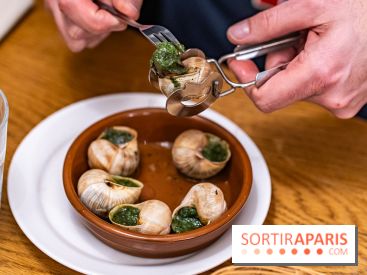
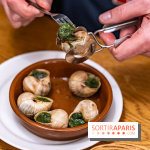
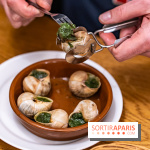
After purging to remove impurities (various techniques are available), the snails are cleaned, cooked and then baked in their shells with traditional parsley butter or local variations (Provençal, Alsatian...). They are often served with special tongs and forks.
Snails are most often served as starters, typically 6 or 12 per person. For a festive meal, they may be offered as a main course (a dozen or up to 24 snails), especially when incorporated into a cassolette, puff pastry or vol-au-vent.
Classic portions:
6 snails: light starter
12 snails: generous starter or light main course
24 snails: rare as a starter, more suitable as a main course for larger appetites or special occasions
And did you know? France isn't the only country to get out its snail tongs: Spain is one of the world's biggest consumers, with around 16,500 tonnes eaten every year in the form of caracoles, often simmered in spicy sauces. In Morocco, street snails - known as ghlal -are enjoyed in a spicy broth with warming properties, much appreciated in winter.
In Europe, countries such as Italy, Greece, Portugal, Belgium and Malta also perpetuate ancient culinary traditions around this mollusc. In Asia, local recipes abound in Vietnam, Laos, Cambodia and Indonesia, where snails are often sautéed or cooked in fragrant soups.
This page may contain AI-assisted elements, more information here.





 Where to eat good snails in Paris? Our best addresses