On September 14, 1791, Olympe de Gouges publishes in Paris Les Droits de la femme, a pamphlet in which appears her Déclaration des droits de la femme et de la citoyenne. Two years after the Déclaration des droits de l'homme et du citoyen, the woman of letters methodically revisits its framework to reveal a contradiction: how can rights be proclaimed "universal" while keeping half the population outside political citizenship? In 17 articles, Olympe de Gouges pushes the 1789 principles to their logical conclusion and demands legal and political equality between the sexes.
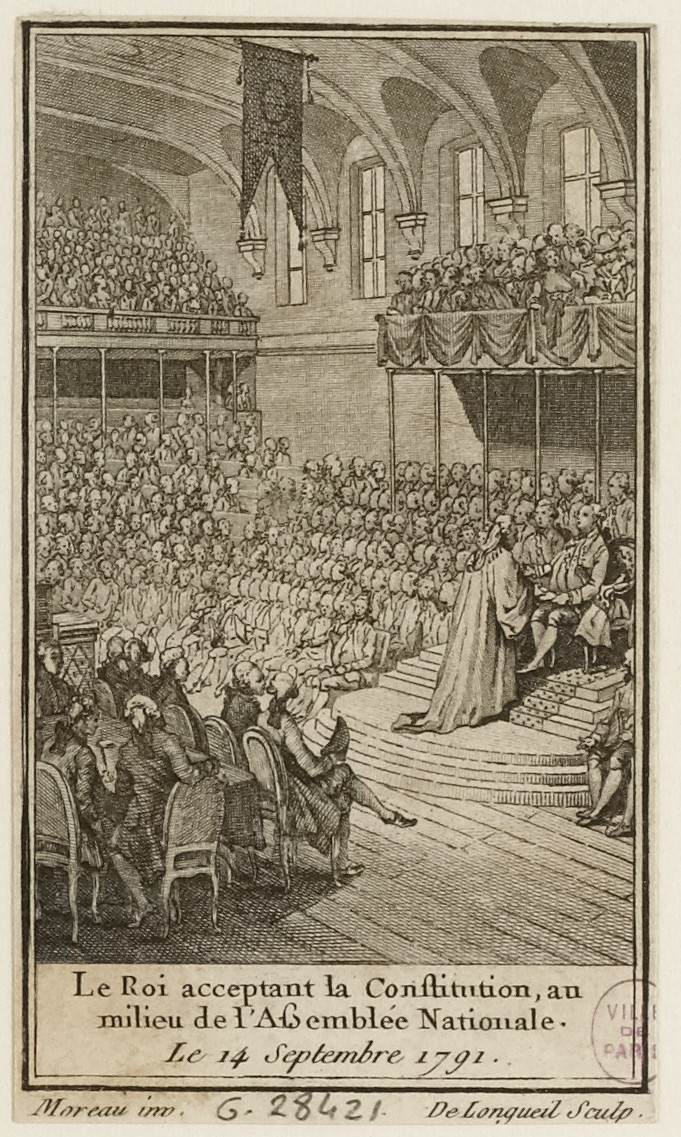
The moment chosen is no accident. France is completing the drafting of its first written constitution. Louis XVI has just accepted it on September 13, 1791 and will swear the oath the next day before the Assembly. The Revolution claims to have deeply restructured the French political order, but women remain excluded from suffrage and national representation. They take part in the revolutionary upheavals, attend the tribunes and clubs, draft petitions, work and pay taxes, without enjoying the same political rights as men.

It's precisely this inconsistency that Olympe de Gouges set out to challenge. Born Marie Gouze in Montauban in 1748, widowed at a young age, she moved to Paris where she carved out a name in letters and in public discourse. Playwright, pamphleteer and political writer particularly prolific, she had already argued for the abolition of slavery, the right to divorce, freedom of expression and various plans for social reform. The Revolution gave her a political stage commensurate with her temperament: she churned out tracts, letters and posters to weigh in directly on the debates of her era.
With the Declaration of the Rights of Woman and the Female Citizen, its method is strikingly straightforward. Olympe de Gouges adopts the structure of the Declaration of the Rights of Man and of the Citizen from August 26, 1789, but replaces the universal masculine with language that explicitly makes women visible.

From the opening article, the principle is stated: "Women are born free and remain equal to men in rights." Article 3 redefines the nation as the union "of women and men." Article 6 insists that citizens—women and men alike—may participate personally or through their representatives in the making of the law and access public offices according to their abilities. Article 13 extends the argument to the fiscal realm: since women contribute to the burdens of society, they must also share in the distribution of jobs, dignities, and responsibilities.
Olympe de Gouges was not merely demanding an improvement to the women's condition, she was raising the question of citizenship itself. If rights are natural and universal, by what principle can we exclude the women?
It is within this reasoning that the sentence, now the text’s most famous line, appears. At Article 10, she notes that "la femme a le droit de monter sur l'échafaud ; elle doit avoir également celui de monter à la tribune". The formulation carries a particular weight in revolutionary France: women are subject to the same penal laws as men and can face the same punishments, but they do not have the same means to participate in the making of these laws.
The Declaration goes even further than the right to vote alone. Olympe de Gouges tackles equality before the law, access to public office, property, the freedom of opinion, and the recognition of children born out of wedlock. In the preamble, she directly urges women to wake up to their situation and criticizes the patterns of economic and legal dependence that underlie marriage. She even envisions a contract between man and woman designed to organize their assets and obligations more equitably!

The text opens with a remarkably bold address to Marie-Antoinette. Olympe de Gouges urges the queen to back the women's cause and even suggests that such a move could restore her prestige. This approach neatly encapsulates the author’s unique political stance: revolutionary in demanding equality, she is not a proponent of a radical republic and remains, at the time, supportive of a constitutional monarchy.
The brochure also offers a revealing instruction: the Declaration is presented "to be decreed by the National Assembly in its final sessions or in those of the next legislature." Olympe de Gouges is not merely drafting a philosophical manifesto; she presents her text as a direct political response to the constitutional order that has just been established.

Her appeal, alas, has no legislative effect. The Declaration is not adopted and French women will have to wait more than a century and a half to obtain the right to vote, granted by the ordinance of 21 April 1944 and exercised for the first time in the municipal elections of 1945. The text by Olympe de Gouges itself experiences a surprisingly late afterlife: for a long time scarcely circulated and largely forgotten, it regains a major place in the history of women's rights in the 20th century.
Her author’s fate, by contrast, tipped quickly as the Revolution radicalized. Olympe de Gouges opposed political violence, aligned with the Girondins, and notably attacked Robespierre. Arrested in July 1793 after the publication of a poster deemed counter-revolutionary, she was brought before the Revolutionary Tribunal and guillotined on November 3, 1793, on the Place de la Révolution, today the Place de la Concorde.

Two years earlier, she had written that a woman who has the right to climb onto the scaffold must also be able to step up to the podium. Posterity has often linked this sentence to her own death, at the risk of reducing the Declaration to a prophetic slogan.
Read the full Declaration of the Rights of Woman and the Citizen
For further reading:
Paris strolls in the footsteps of the great feminist figures who have left their mark on history
Follow in the footsteps of the great women and feminists who have left their mark on French history, discovering the intimate and public places of their lives, in the heart of Paris. [Read more]
This page may contain AI-assisted elements, more information here.
Dates and Opening Time
On September 14, 2026
Location
Place de la Concorde
Place de la Concorde
75008 Paris 8
Route planner






























 Paris strolls in the footsteps of the great feminist figures who have left their mark on history