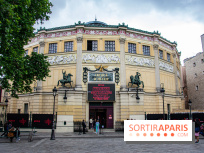
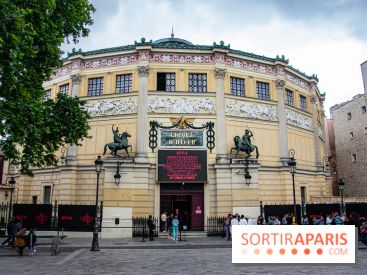
Today, the Cirque d'Hiver, run by the Bouglione family, is a veritable circus landmark in the capital. But its counterpart, the Cirque d'Été, existed between 1841 and 1900, on the other side of Paris, on theAvenue des Champs-Elysées! Also known as the Cirque-Olympique des Champs-Élysées or Cirque de l'Impératrice, this Parisian venue was built in the same style at the time, with its rotunda structure.
Initially a simple board and canvas circus installed in 1835 by Adolphe Franconi, grandson of the Cirque-Olympique's creator, it was replaced in 1841 by a vast 6,000-seat building designed by Jacques Hittorff. It presented its shows only from May to September, hence its summer name, as opposed to the Théâtre du Cirque Olympique, which opened in winter. It wasn't until 1852 that the Cirque d'Hiver was built, so that artists could perform year-round, at the request of Louis Dejean!
Cirque d'Été was particularly popular during the Second Empire, when it was known as Cirque de l'Impératrice, until 1880, when it was abandoned by the public after the ParisUniversal Exhibition in 1889. It was demolished around 1900, leaving its name to the present Rue du Cirque.
Cirque d'Hiver de Paris, one of Europe's oldest circuses
Located near Filles du Calvaires, in the 11th arrondissement of Paris, the Cirque d'Hiver is a historic venue with neo-classical architecture. One of the oldest permanent circuses in Europe, it continues to showcase the circus arts to the delight of families. [Read more]

































 Cirque d'Hiver de Paris, one of Europe's oldest circuses