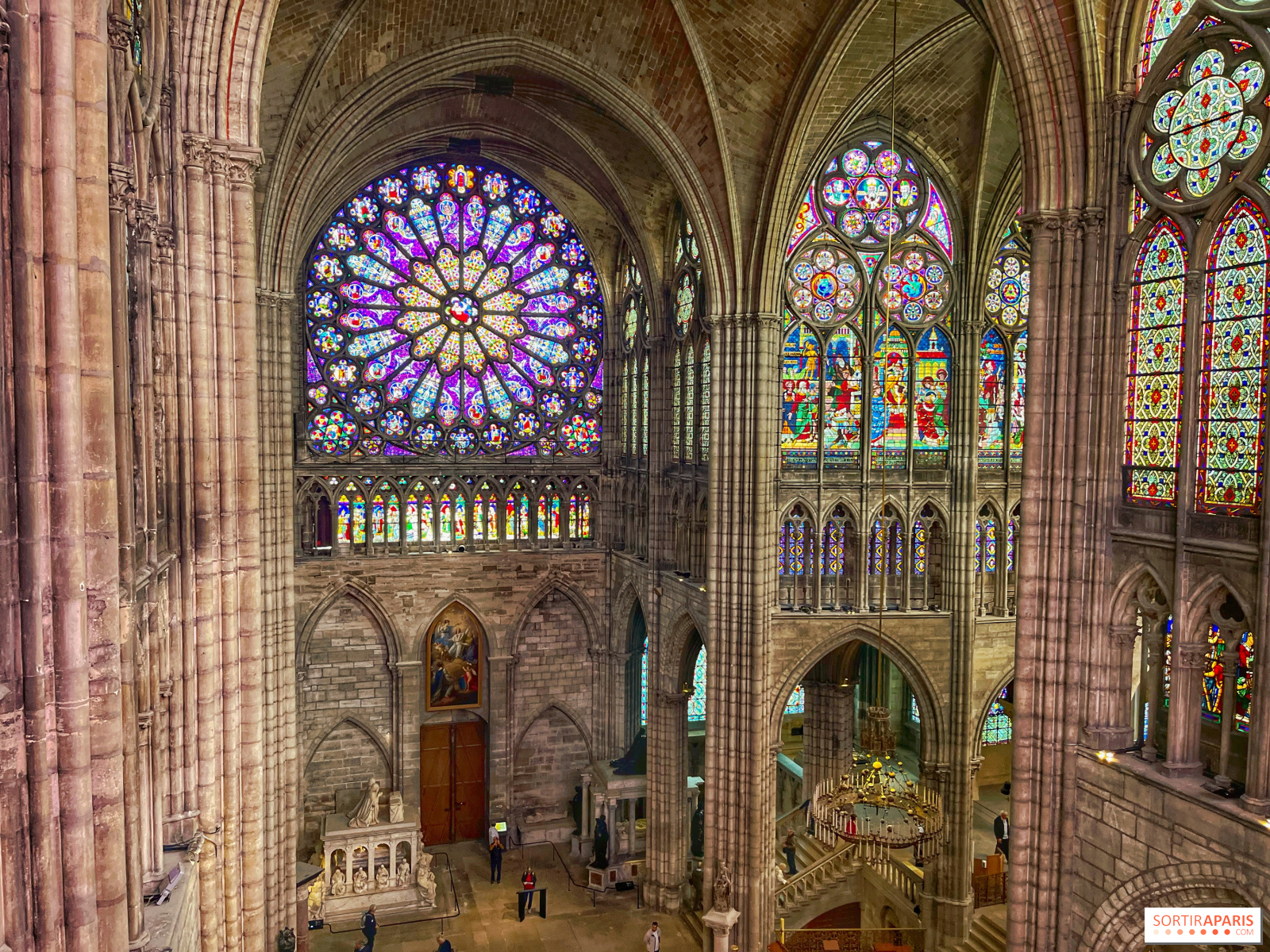
We are fortunate, in the capital and throughout the Île-de-France region, to benefit from an exceptionalheritage, whether in terms of monuments or know-how. In our new series,"Les Gardiens du Patrimoine", we meet the men and women who strive to safeguard this heritage on a daily basis, bringing it to life and making it better known, so that it will endure through the centuries. An opportunity to discover their passion and learn more about this veritable treasure, both tangible and intangible.
In this second episode, we take a tour of the Basilique Saint-Denis, where we meetAlbanne Cadennes, a stonemason who is passionately working to bring the spire, destroyed over a century ago, back to life. It's also an opportunity to talk about the Fabrique de la Flèche, a space open to the public where you can find out more about the worksite and learn about the trades of yesteryear, starting in October 2025!
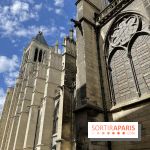
Saint-Denis Basilica, the necropolis of the Kings of France in Saint-Denis (93), discover its history
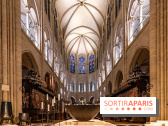
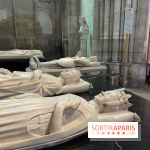
How about (re)discovering the Basilique Saint-Denis? Classified as a historical monument, this religious edifice in Saint-Denis (93) is home to the necropolis of the Kings of France, and is a must-see for history buffs and those curious about the region's heritage. We tell you all about it! [Read more]
It's a historic year for the Basilique Saint-Denis, with a major worksite beginning in March 2025. The laying of the foundation stone launched work on rebuilding the tower and the north spire, which used to stand over 90 m high. Dismantled some 180 years ago by architect Eugène Viollet-le-Duc after having existed for centuries, it was set aside due to structural fragilities after lightning struck it.
He had planned to reassemble it, but this never happened in his lifetime, and it was not until this year that his dream came true, thanks in part to theassociation Suivez la Flèche! Except that it will take around 15,000 more stones, says Noémie Nunes, head of communications at the Centre des Monuments Nationaux, and almost 5 years for the stonemasons to complete it. Meet Albanne, who is working on the site and helping to rebuild history.
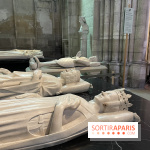
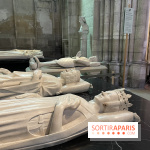
Between original or touching anecdotes and French history, Noémie Nunes, in charge of communications at CMN, reveals the treasures of the Basilique Saint-Denis, whose spire is about to be reborn thanks to an extraordinary worksite. [Read more]
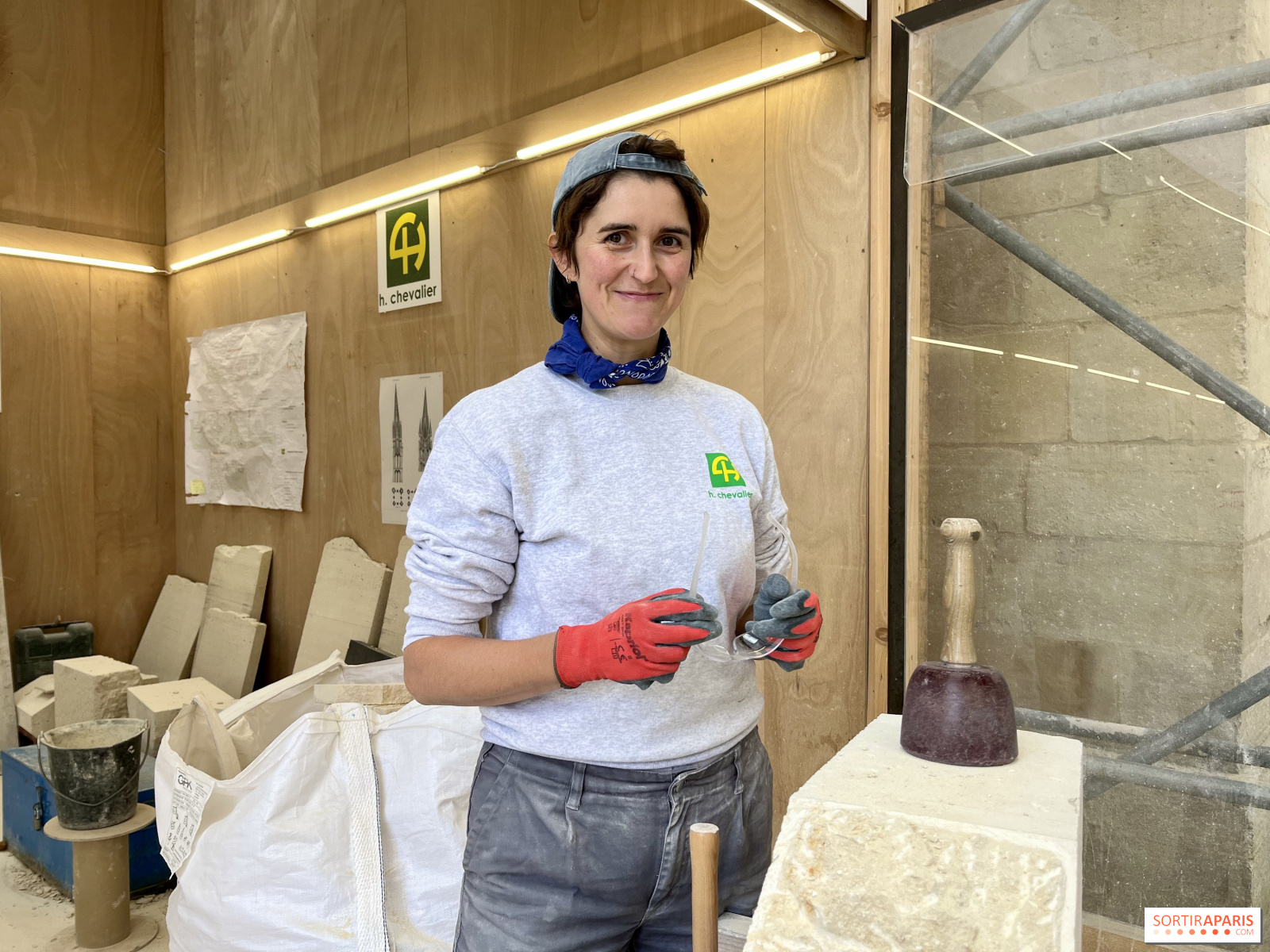
My name's Albanne Cadennes, I'm a stonemason, and I've been doing this for a whole year now.
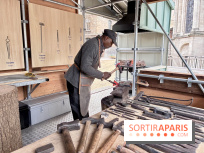
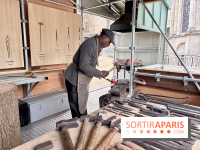
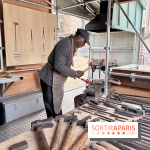
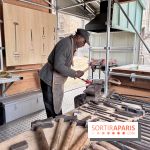
My role on the site is to receive the stones, which come in the form of large slabs that we cut to size. Once the stones have been cut and numbered, and we know exactly where they're going, we go and deposit them further down the site. That's part of the cutter's role.
I think what's special about this site is that here, at the foot of the basilica, we're really working with ancient techniques. We don't use any machines, we only work by hand, and our tools are virtually the same as they've been since the Middle Ages.
It's really interesting for us apprentices, because it pushes us to work very finely, and to take the time to learn the traditional tools.
Another special feature, which is really quite exceptional and extraordinary, is thatwe work at the foot of the building we're constructing. That's quite rare in the construction industry, and it allows us to check out some of the major elements and aspects - it's a great opportunity!

So when a stone arrives, it's huge in fact, in the form of large slices measuring around 2 m by 1.50 m. The stonecutter then cuts it into several pieces. The stonemason then cuts it into several pieces, which in practice means playing Tetris and trying to fit as many blocks as possible inside this large slice.
Each of these stones is carefully cut by our little hands, and numbered, which is very important to know exactly where it should go, on which pillar for example, which foundation, and so on. And then they're stored until they're taken to the building site to be laid, masoned and deposited, hopefully for centuries to come!
The stones come from not far from here, from a quarry in the Oise, Saint-Leu, Saint-Maximin.
The most important thing to start with is the layout of the stone, the final design, on the top of the stone, for example a column element I'm cutting. I'm going to proceed by epannelage. This means that I strategically remove material layer by layer in very geometric, well-designed shapes, to remove as much as possible at once. In the end, I'll end up with a rounded shape, even though I didn't cut it directly like that, just lines.
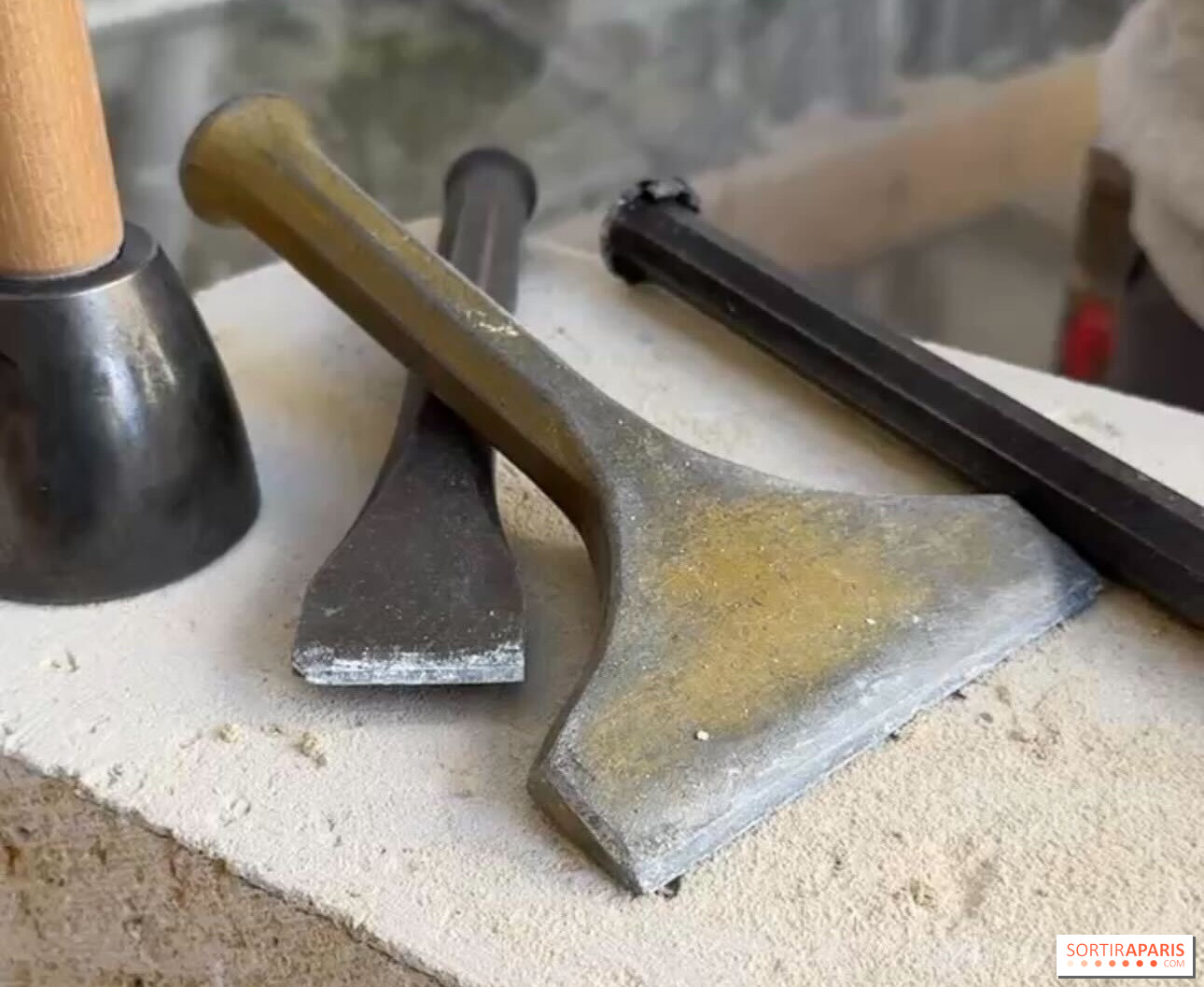
It's a method that allows us to cut correctly and always square. Then I use a chisel and a bakelite bowl mallet. With the chisel, I'm able to chisel with a certain degree of precision, attacking the outline of my epannelage. Once that's done, I'll take a plough, a bigger chisel, a wider chisel, so I can remove more material all at once, and go gradually to be more and more precise.
I still have quite a bit of material to remove, so I'm going to use the spindle, which removes quite a lot at once, and I'll continue like this along the whole width of the stone.
I've wanted to workwith stone for a very long time, because I think it's a very noble, magnificent and diverse material. I'm very interested in stone in all its forms, so it's a bit of a geological passion! I'm very happy to be learning to work with it, and it's also a love of building, of the magnificent elements we have in Paris, cathedrals and other churches... It really made me want to learn to do this job and to build.
To get that far, you take a CAP (vocational training certificate), and if you want to go on to a BP (vocational diploma) in stonemasonry, I did that at the Compagnons du Devoir in Champs-sur-Marne.
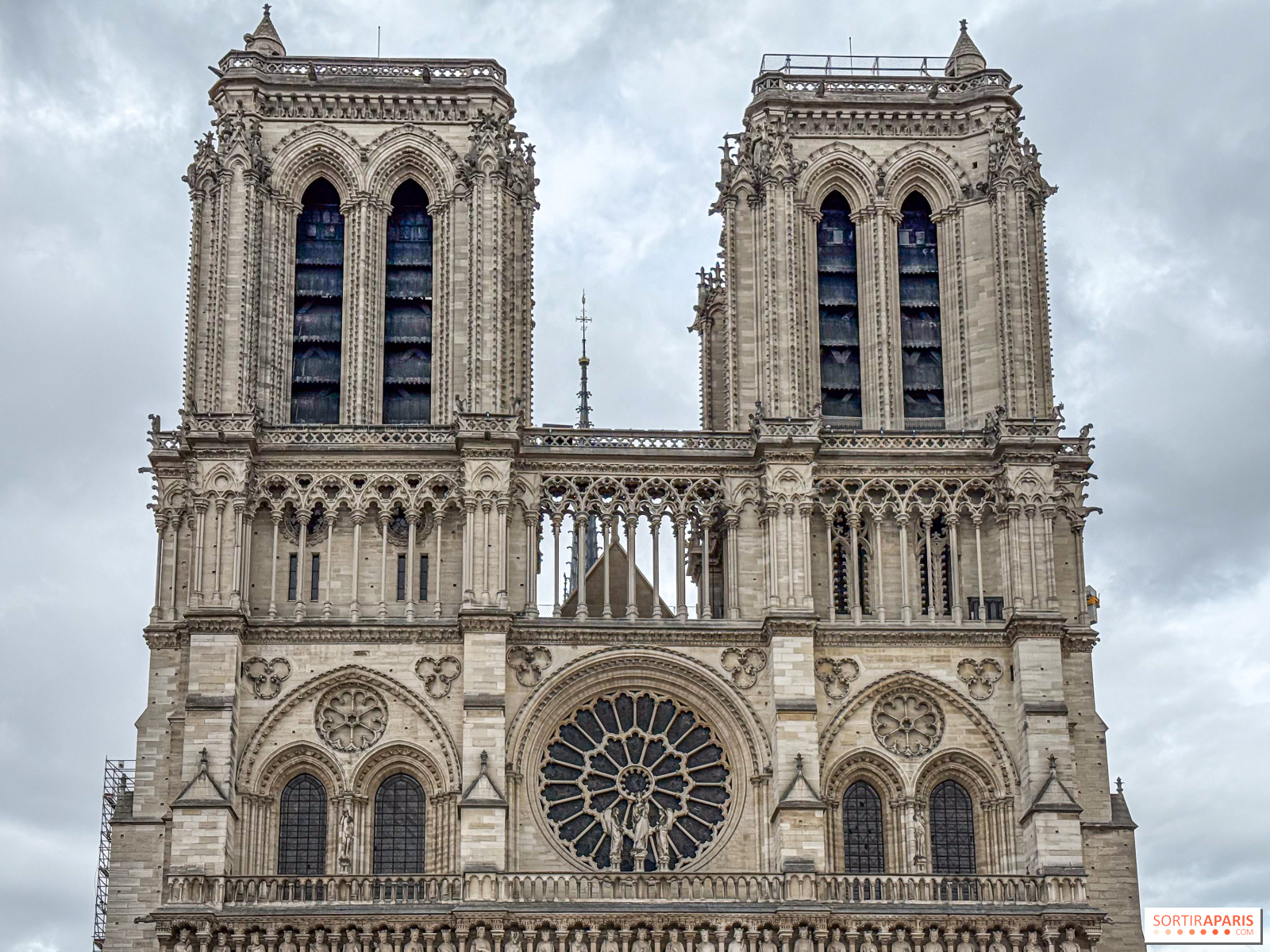
I've already worked on Notre-Dame de Paris, which was my very first site! It was my very first day in stonemasonry, and I was so lucky. Everything was so interesting, just like there!
Above all, it's a privilege, and I know that not all apprentices are so lucky. It's incredible to follow in the footsteps of someone who started this so long ago!
I knew a little about it of course, I'd been here once before, and I knew that the kings and queens of France were buried here. But no, I didn't know the particularities of its architecture, its whole history, I discovered it all when I arrived here. What drew me here, apart from the work, was the beauty of the place - it's superb! I was lucky to end up here!
I have the impression that yes, there are plenty of people who have said to themselves"wow", watching documentaries, even seeing girls on the building site, they may have told themselves that in fact they too could do it. Because sometimes, as a woman, you can forbid yourself from going into construction. I think it gave some people ideas.
Before I started, I told myself that one day I'd be working on Notre-Dame de Paris, and this was my very first day, so that's good! I was so lucky! It was a bit of a symbolic dream. But there are plenty of others coming up that I haven't even heard of yet!
We cut stones here, at the lodge, and right next door there's this Fabrique de la Flèche (Editor's note: by the association Suivez la Flèche) which will open in October, with immersive experiences, sound and light, stone-cutting initiation workshops, and a small blacksmith's workshop, I believe, all to be discovered soon. It's going to be great!
By 2029, the Basilica of Saint-Denis will have regained its spire on the north tower, which disappeared centuries ago. But while waiting for the work to be completed, you can visit the site and discover the expertise required for this restoration, starting October 17, 2025, with stone cutting, a forge workshop, and sound and light shows! [Read more]
I think there's a craze for this kind of project. Reconstructing the spire is extraordinary, it's a real boost for the town. Having done a few workshops with children, we can see that they love it, they're even quite gifted, so it's going to be really interesting for a very wide audience!
We look forward to seeing you in October!
On the occasion of their new show "Spectaculaire", we met up with Joseph and Louis-Sampion Bouglione to talk about flying trapeze, a skill born at the heart of the Cirque d'Hiver, one of the capital's most historic venues. [Read more]
Location
Saint-Denis Basilica
1, Rue de la Légion d'Honneur
93200 Saint Denis
Official website
www.suivezlafleche.com







 Saint-Denis Basilica, the necropolis of the Kings of France in Saint-Denis (93), discover its history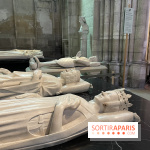
 3 original anecdotes about the tombs of the kings and queens of France at the Basilique-Saint-Denis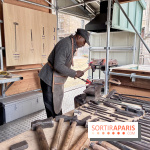

 Fabrique de la Flèche: immersive cinema, workshops, and a tour of the construction site at the Basilica of Saint-Denis


 Meet the Bouglione family: flying trapeze at Cirque d'Hiver, our interview