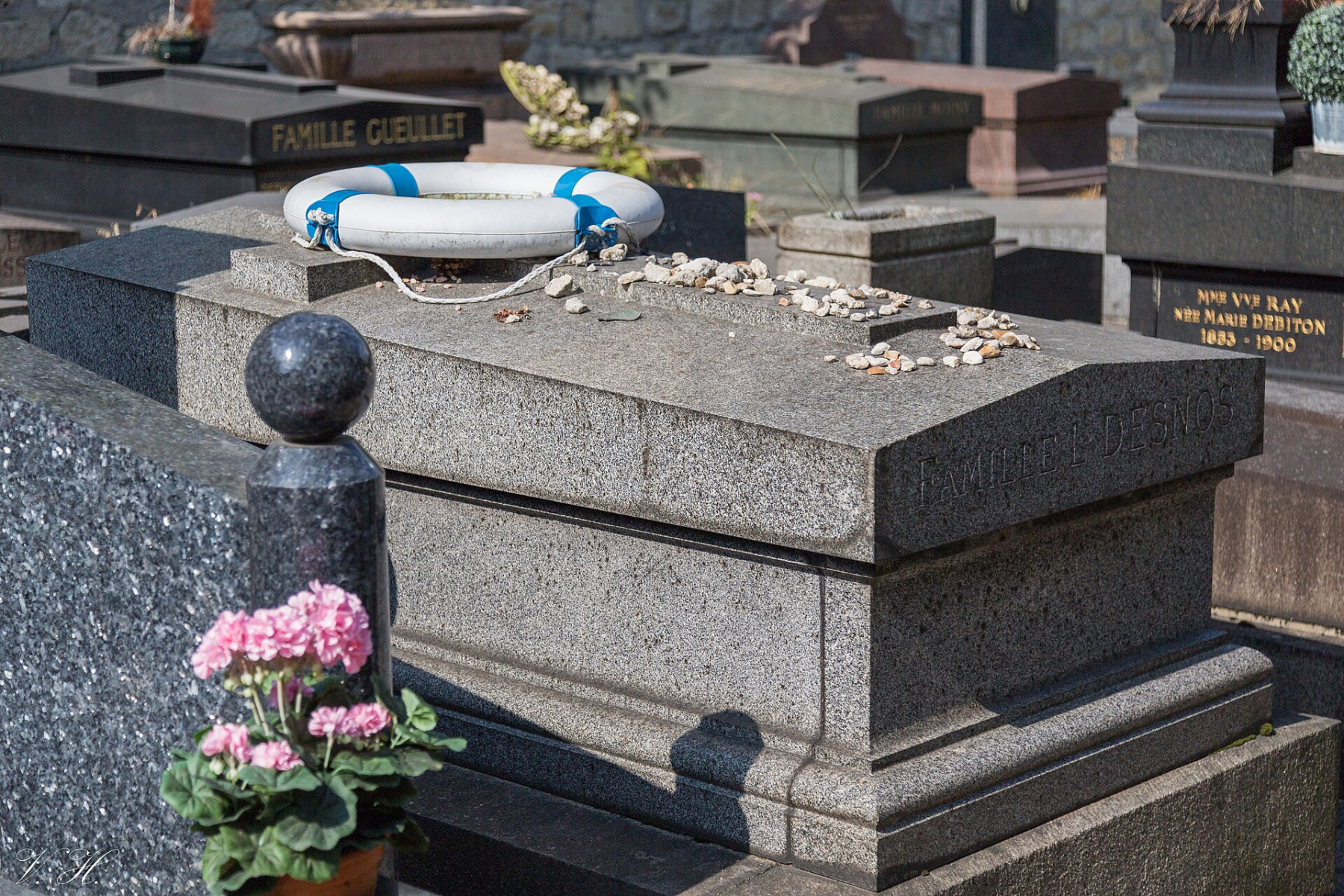
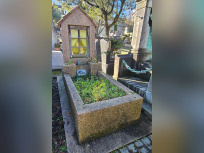
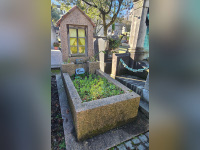
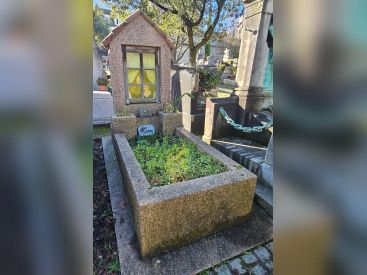
What an odd precaution for someone who lies six feet underground! At Montparnasse Cemetery, in Paris’s 14th arrondissement, an unusual grave displays a most unexpected object: a blue-and-white life buoy! There’s no boat in sight, nor even a drop of water… So what is this strange nautical accessory doing on a Parisian grave? To understand the mystery, we need to look into the story of its occupant, Robert Desnos (1900–1945), a surrealist poet who certainly had a sense of humor!
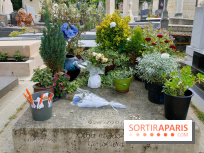
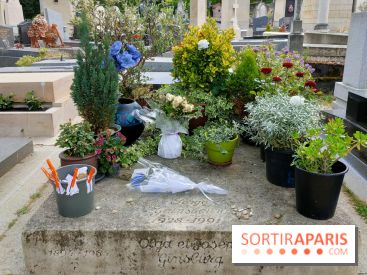
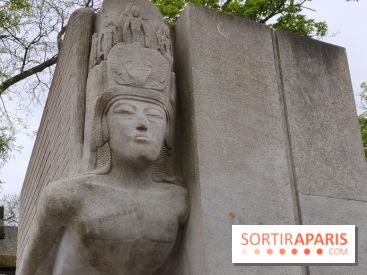
At first glance, there is nothing particularly distinctive about this grave. A simple headstone, a few small stones left as a tribute… and that famous buoy, seemingly waiting for a shipwreck survivor! Yet its presence is no coincidence.
To understand its origins, we have to go back to 1923, when Robert Desnos published a poem titled The Poet’s Great Days in the literary journal Littérature, then edited by André Breton. After a succession of increasingly unexpected images, the writer ends his text as follows:
“You’ll put a life preserver on my grave. You never know.”
A most unusual request! And now, years after his death, an actual buoy has been placed on his final resting place. This is not a tribute to some seafaring past, but rather a nod to the poet’s boundless imagination!
Born in Paris in 1900 and raised in the Les Halles district, Robert Desnos was one of the leading figures of Surrealism, the artistic and literary movement that seeks to free the imagination from the constraints of reason.
Developed in the 1920s around André Breton, Surrealism explores dreams, the unconscious, free association and automatic writing, a technique that involves letting words flow without subjecting them to the usual constraints of logic. And Desnos is particularly gifted in this field! Able to improvise astonishing texts during hypnotic sleep sessions, he plays with words, images and absurd situations. A talent that would be embodied even in his final resting place.
But behind this touch of humor lies a far darker fate. During World War II, Robert Desnos joined the Resistance, notably as part of the Agir network. He took part in the clandestine struggle against the Nazi occupiers.
Arrested on 22 February 1944, he is imprisoned and then deported to several concentration camps. After a harrowing ordeal, he arrives at Terezín, in what is now the Czech Republic. Weakened by the conditions of his detention, he dies there of typhus on 8 June 1945, just a few weeks after the camp’s liberation. He was 44. His memory lives on today in Montparnasse Cemetery, where this lifebuoy stands as a tribute that is as unusual as it is moving.
To discover this remarkable grave, head to Division 15 of Montparnasse Cemetery, accessible, among other routes, through the main entrance at 3 Boulevard Edgar-Quinet. And while the lifebuoy may at first bring a smile, it also prompts a lovely reflection: could it symbolize the hope of never sinking into oblivion? Nearly a century after writing his verses, Robert Desnos still surprises passersby with a simple lifebuoy. It just goes to show that even in a cemetery, poetry can still help us keep our heads above water!
This page may contain AI-assisted elements, more information here.
Location
Montparnasse Cemetery
3, boulevard Edgar Quinet
75014 Paris 14
Route planner
Accessibility info