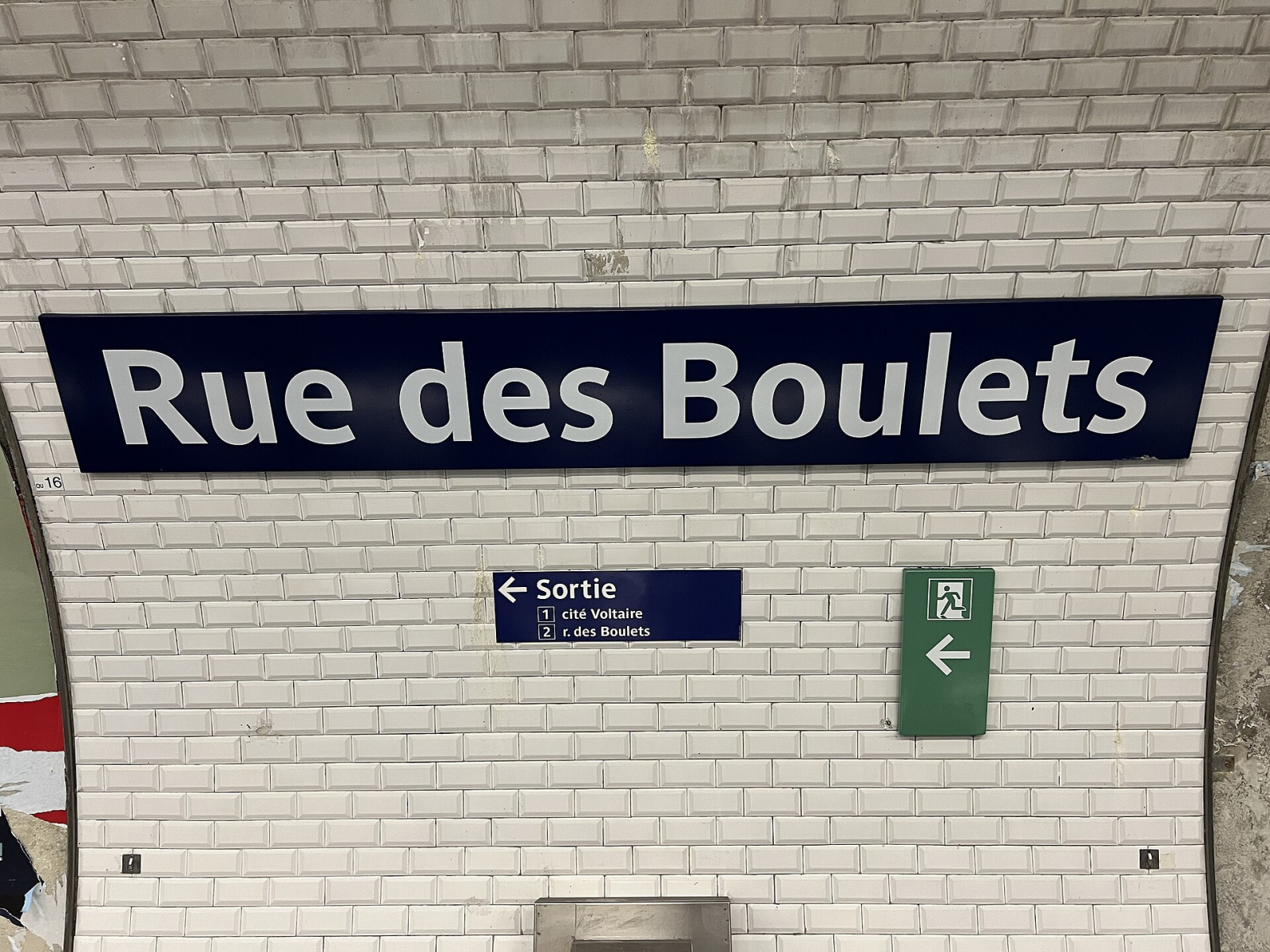
Along line 9, "Rue des Boulets" is a name that intrigues and sometimes makes you smile. If you find yourself thinking of someone who often makes blunders, you're often unaware of the true origin of this station in eastern Paris.
Rue des Boulets is much older than the metro itself. It can be found on maps of Paris as far back as 1672, when Versailles was still taking its first steps and the Paris suburbs were a cheerful mix of fields, workshops and dusty roads.
The most widespread version is that "boulets" refer to modest but very useful coal balls. These compact, black bricks of fuel were sold to heat Parisian homes. Easy to stack, transport and burn, they would have given their name to the street, which may have been a place of transit or trade.
It's also not uncommon in Paris to come across street names derived from local economic activities: rue de la Forge-Royale, rue de la Corderie, rue des Filles-du-Calvaire (but that's another story).
A second, more bucolic hypothesis suggests that "boulets" is an alteration of "boulaie", meaning a place planted with birch trees. This kind of phonetic transformation is not uncommon, especially when the centuries are involved. Can we imagine a small birch forest in the heart of what would later become the 11ᵉ arrondissement? I don't see why not.
Some suggest a more martial origin: "boulets" could refer to artillery projectiles, perhaps manufactured or stored in the area. At certain times, the area was home to metal craftsmen and workshops close to the old fortifications. There's no way of confirming this, but it illustrates just how much Parisian street names can preserve the memory of much more eventful pasts than appearances might suggest.
The Rue des Boulets station opened on December 10, 1933, when line 9 was extended eastwards. At first, it bore the rather long name of Rue des Boulets - Rue de Montreuil. In 1998, to lighten the sign (and avoid losing tourists), it became simply Rue des Boulets.
Fun fact: the street itself has changed over time. In 1944, its northern section was renamed rue Léon-Frot, in homage to a town councillor and Resistance fighter. But the southern section retains its historic name... and has been the source of riddles for metro passengers for over 90 years.
This page may contain AI-assisted elements, more information here.