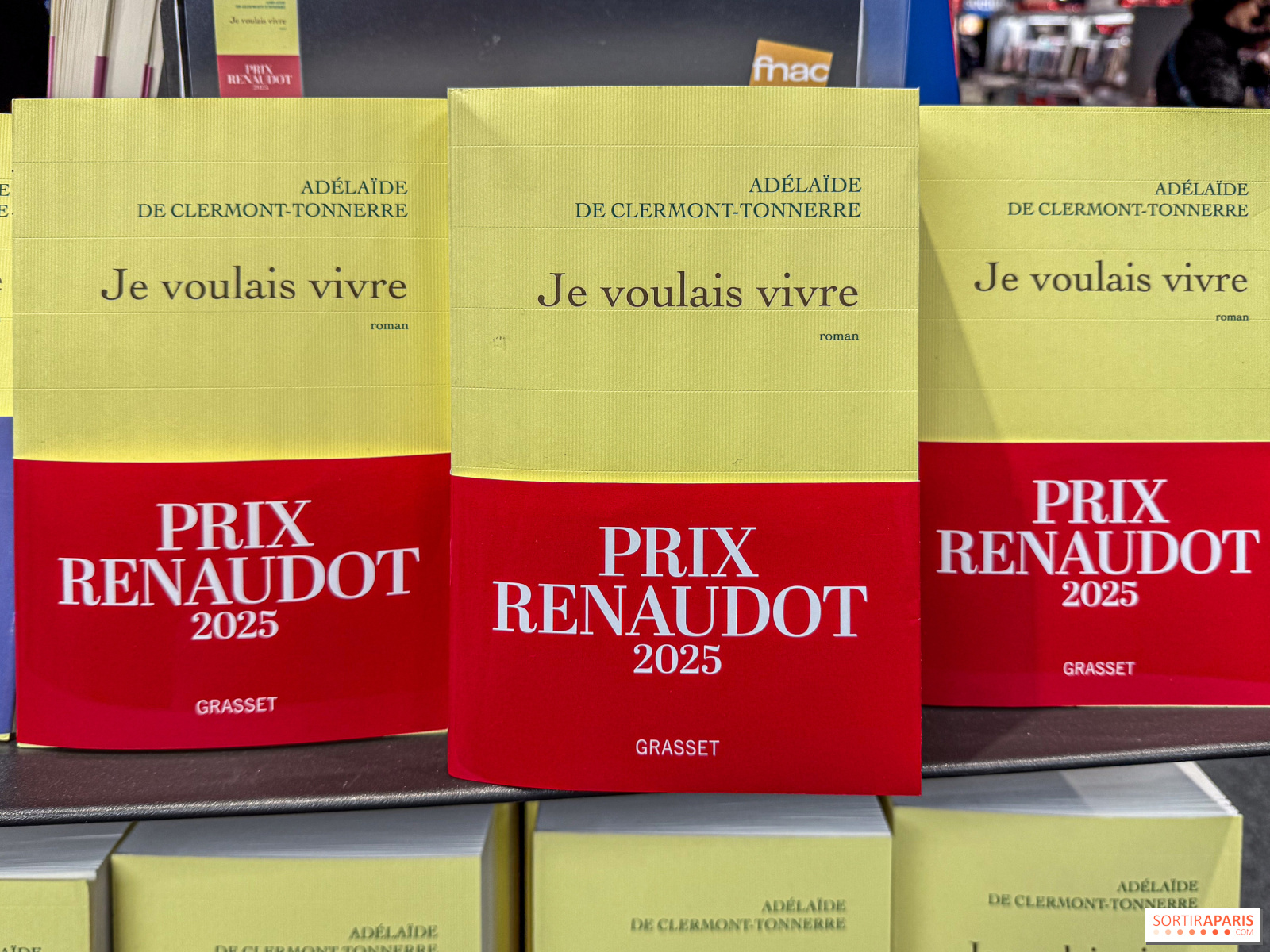
On Tuesday, November 4, 2025 ,the Prix Renaudot 2025 was awarded to Adélaïde de Clermont-Tonnerre forher novel Je voulais vivre, published by Grasset. The announcement took place at the legendary Drouant restaurant in Paris's 2nd arrondissement, near the Opéra Garnier. This prestigious literary prize rewards a daring work that gives a voice to one of the most fascinating and reviled female characters in French literature: Milady de Winter, the sworn enemy of Alexandre Dumas's Three Musketeers.
Since 1926, the Renaudot jury has been meeting in this iconic restaurant on Place Gaillon, a veritable temple of Parisian literary prizes that has also hosted the Goncourt deliberations since 1914. This century-old tradition makes Le Drouant an essential part of Parisian cultural life. The ten jurors, chaired by Patrick Besson and including Jean-Marie Gustave Le Clézio, Franz-Olivier Giesbert, and Dominique Bona, chose Adélaïde de Clermont-Tonnerre over four other finalists, including Feurat Alani for "Le ciel est immense" (JC Lattès), Anne Berest for "Finistère" (Albin Michel), Justine Lévy for "Une drôle de peine" (Stock), and Louis-Henri de La Rochefoucauld for "L'amour moderne" (Robert Laffont).
Je voulais vivre offers a captivating reinterpretation of Alexandre Dumas's The Three Musketeers. Adélaïde de Clermont-Tonnerre tackles a monument of French literature by finally giving a voice to Milady, that free and dangerous woman who was judged without a lawyer and executed without trial by the Musketeers. In Dumas' novel, she embodied the quintessential femme fatale: scheming, poisonous, and a spy for Cardinal Richelieu. But what do we really know about her story?
The author shifts the spotlight to Anne de Breuil, Milady's real name. Through the confessions of an aging d'Artagnan during the siege of Maastricht, we discover a childhood marked by violence and a life punctuated by betrayals and tragedies. The novel tells how this six-year-old girl, taken in by a priest, became the elusive woman who had to defend herself to survive in a world made by and for men. Branded with a hot iron, forcibly married to the Count of La Fère (Athos), and the victim of an assassination attempt by her own husband, Milady learned to carry a dagger and poisons in her bodice. For in order to be free in the 17th century, a woman had to know how to defend herself.
With her contemporary writing style and powerful romanticism, Adélaïde de Clermont-Tonnerre does not betray Dumas' work, but rather enriches it. She follows the clues that the author of The Three Musketeers left behind without taking the time to develop them. Readers will find the same places, the same court intrigues, and the same iconic characters—d'Artagnan, Athos, Porthos, Aramis, Richelieu, Buckingham—but in a new light. The flamboyant heroes become fallible men, prisoners of their time and their patriarchal vision.
This is not the first time Adélaïde de Clermont-Tonnerre has been honored with the Prix Renaudot. Born in 1976 in Neuilly-sur-Seine and a former student of the École Normale Supérieure, this journalist and novelist first worked in investment banking before turning to journalism. Editor-in-chief of Point de vue since 2014, she has had a remarkable dual career. Her first novel, Fourrure, published in 2010, had already won five literary awards, including the Maison de la Presse Prize and the Françoise Sagan Prize.
In 2016, she won the Grand Prix du roman de l'Académie française for "Le Dernier des nôtres," a historical epic of nearly 500 pages spanning World War II and the 1970s in America. The Académie Française praised her imaginative writing and her ability to create authentic fictional characters, far removed from the prevailing trend of autofiction. Her third novel, Les Jours heureux, published in 2021, also won an award.
With Je voulais vivre, the author continues her exploration of great historical frescoes and the destinies of strong women. The novel, published on August 20, 2025, had already sold nearly 25,000 copies before the prize was announced. Traditionally, the winner of the Renaudot Prize is announced immediately after the winner of the Goncourt Prize, on the steps of the famous Ruhlmann staircase at the Drouant restaurant. This year, Laurent Mauvignier won the Goncourt Prize for "La maison vide"(The Empty House).
Beyond the romantic adventure and the pleasure of reading, "Je voulais vivre" (I wanted to live) makes a topical statement about the status of women. By rehabilitating Milady, Adélaïde de Clermont-Tonnerre questions the way women have been judged throughout history. Where a man would have been described as courageous or intelligent, Milady was branded indecent and Machiavellian. Condemned without trial, executed without being able to tell her story, she embodies all those women silenced by a male-dominated justice system. The novel resonates with current questions about the place of women in our stories and legends.
The title itself, "Je voulais vivre" (I wanted to live), becomes a universal cry, that of a woman demanding the right to be loved, respected, and free. Even a fictional character can demand justice, the author seems to be telling us. This contemporary voice that spans the centuries allows for immediate closeness with the reader, creating a bridge between the 17th century and our own time. The court scenes, the sharp dialogue, and Milady's intimate journey literally keep us hanging on every word of the story.
In short, if you're looking for a good read for this fall, check out this novel that combines quality writing with reading pleasure. It's a great way to rediscover The Three Musketeers from a new angle and finally understand who Milady really was, the woman we thought we knew. The novel is available in bookstores from Grasset for €24.