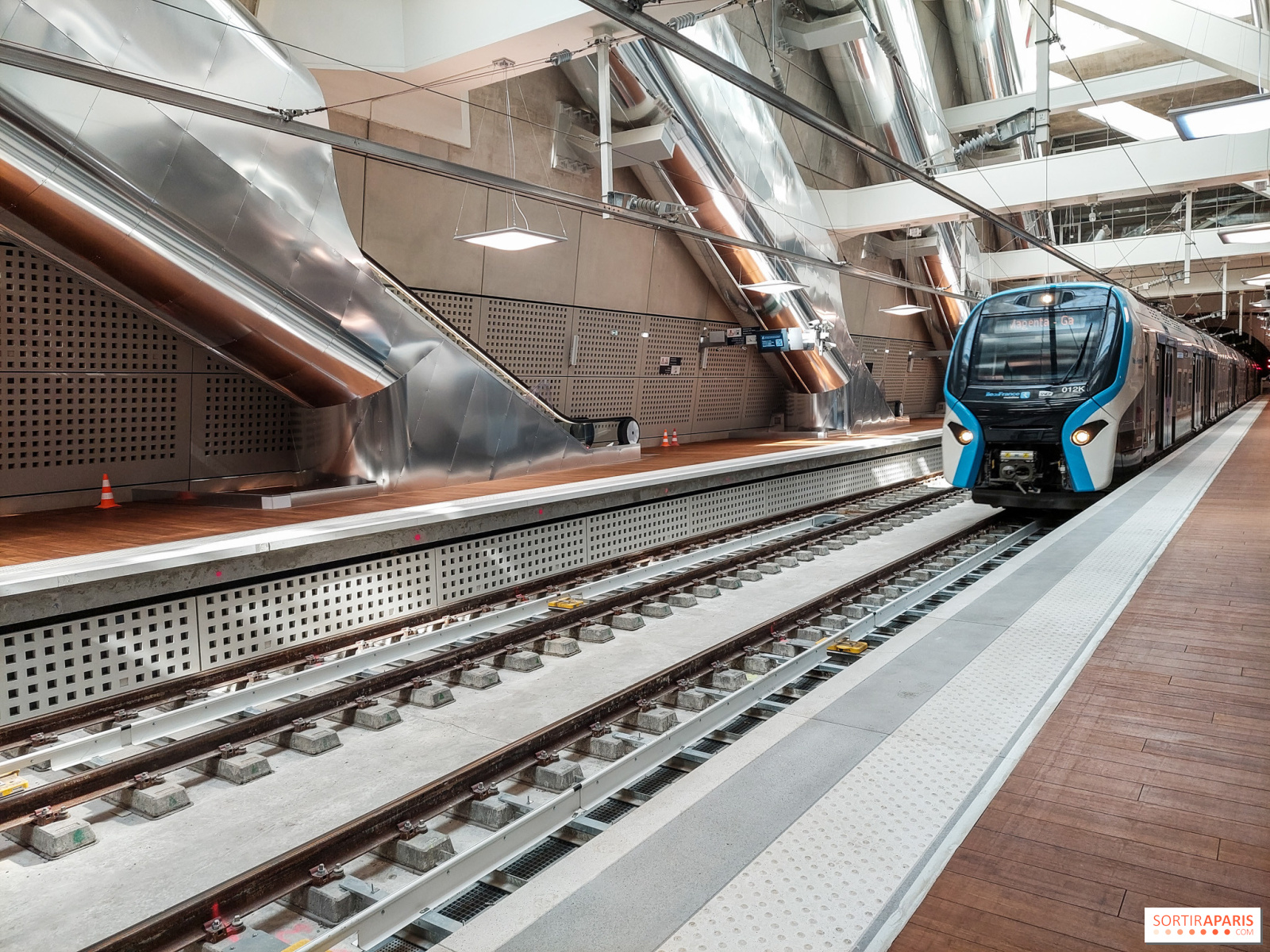
Have you ever wondered what the names displayed at the front of RER trains, on display screens, and on timetables mean? If you look closely, each RER train has a specific name. If you are waiting on the RER E platform, you may board the COHI, HOVE, or TAVA train. If you need to take the RER C, you'll come across MONA, ROMI, SARA, or VICK. But what do these acronyms mean? And how were these letters chosen?
Called "mission codes," these names have a very specific meaning. "Mission codes allow you to know the service of a train. It is a reference point for SNCF agents but also, and above all, for you (customers) who, taking the train very regularly, know whether a particular train is local or semi-direct," explains the RER D website.
As explained in the blogs of the various RER lines in the Paris region, the first letter of this "mission code" indicates the train's destination. "Mission codes are chosen according to the train's destinations, and this is the only invariable rule," explains the RER C website. With a few exceptions, the code is the initial letter of the station in question. Take the example of the RER E: the "C" in COHI corresponds to Chelles Gournay, while the "V" in VOHA is used for Villiers-sur-Marne and the "T" in TAVA refers to Tournan.
What about thesecond letter? This refers to the type of service. The letter "O" is used for omnibus services, the letters "I" or "Y" for the most direct services, "U" for semi-direct services and finally "A" for semi-direct and the most comprehensive services.
Still on the RER E, thethird letter of this "mission code" provides information on intermediate stations and thus repeats the initial letter of the station concerned. For example, we have "H" for Haussmann Saint-Lazare, or "V" for Villiers-sur-Marne. For example, the COHI train is bound for Chelles-Gournay and is an omnibus train from Haussmann Saint-Lazare, while the HOVE train is bound for Haussmann Saint-Lazare and is an omnibus train from Villiers-sur-Marne.
Finally, thefourth letter indicates the line traveled, namely "A" for the Tournan line, "E" for the Villiers-sur-Marne line, "I" for the Chelles Gournay line, and "Y" for the Haussmann Saint-Lazare <> Magenta shuttle.
This "mission code" system also works on other RER lines, with a few exceptions. On the RER C line, for example, some "mission codes" do not follow the rule, such as the letter "I" for Ermont-Eaubonne, "K" for Chaville-Vélizy, "L" for Invalides, and "N" for Pontoise. The same applies to the RER A line, where a "mission code" beginning with the letter "Q" indicates the Marne-la-Vallée–Chessy terminus, "T" designates the Poissy terminus, and "Y" indicates the Rueil-Malmaison terminus.
Furthermore, on RER lines A and B, the third and fourth letters ofthe"mission code" are purely phonetic. "They provide no indication of the train's route. The mission codes are designed by the Timetable Departments of the Unified Management of Lines A and B, which work to develop harmonious combinations. This ensures that trains can be easily identified in the event of an incident, for example, or on a daily basis when calling drivers," according to the RER A and B websites.

On the RER A and B lines, two digits are also added to the four letters. These provide information about the direction of the trains. On the RER B line, odd numbers indicate trains heading north, and even numbers indicate trains heading south. On the RER A line, even numbers run from west to east, while odd numbers run from east to west.
As for the RER C, since the update in December 2022, it has been decided that the last three letters should have evocative names to make them easier to remember. These include first names such as ROMI, SARA, NORA, and LARA.
In addition to providing passengers with information about the destination station and train service, thesemission codes also ensure that passengers are taken care of during construction work. "When service changes are made, a new mission code is set up and recorded so that it can then be recognized by the passenger information system," according to the RER E website. "They are also useful for the driver: by identifying the mission code, he activates the SIVE (Onboard Passenger Information System). This allows the appropriate announcements to be made on board," it adds.